Sweden Brings Its Own State Contractor Onto an Alliance Deal to Plan and Build the E22 Bypass at Bergkvara
Standfirst
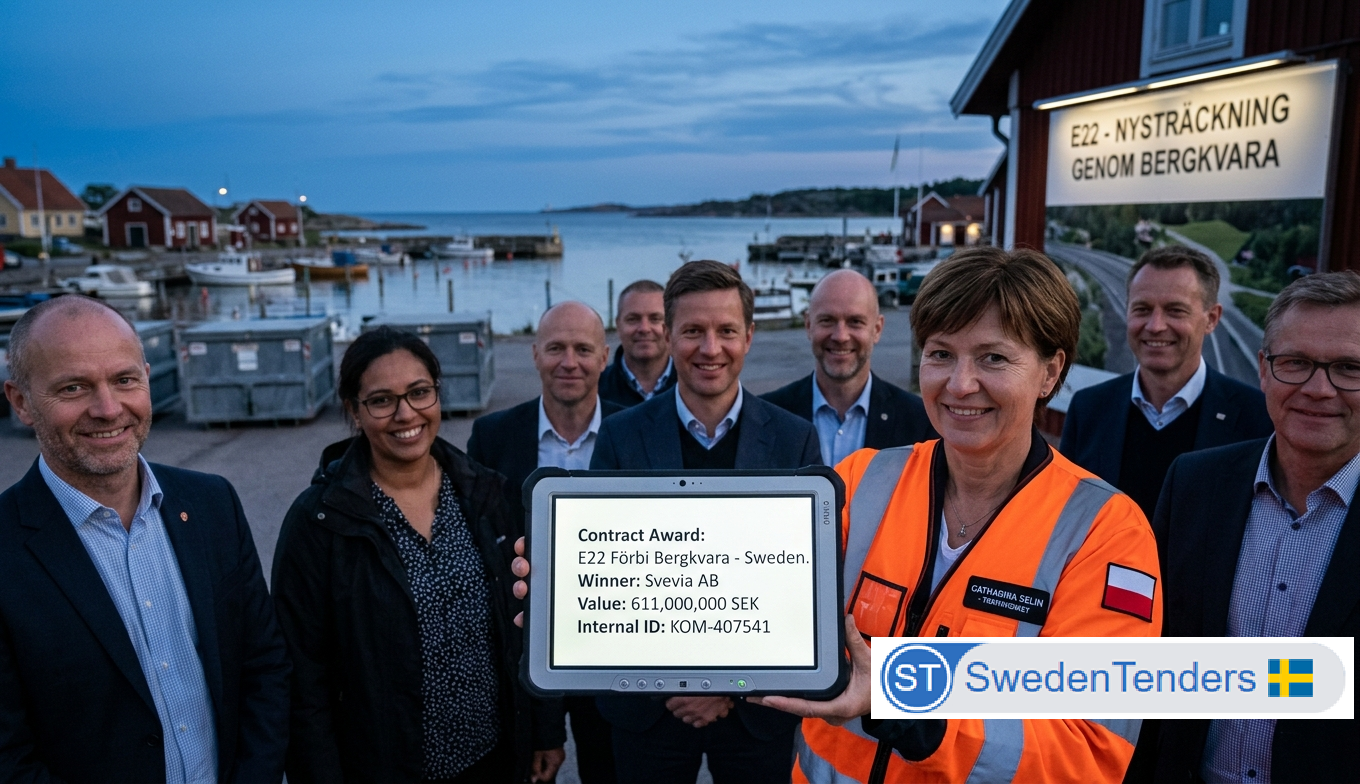
Trafikverket, the Swedish Transport Administration, has awarded Svevia AB a SEK 611 000 000 alliance contract to help plan and eventually build a bypass of the E22 highway at Bergkvara in Kalmar county. The deal runs until the end of 2032, drew only one tender and pairs one Swedish state body with another, since Svevia itself began life as part of Trafikverket before being spun off in 2010.
Introduction
Not every road contract starts with a finished design. Sweden's E22 bypass at Bergkvara begins instead with a collaborative planning phase, where the contractor sits alongside Trafikverket's own planners to shape the road before construction ever starts, an approach meant to catch buildability problems and cost risks early rather than after the drawings are locked in.
Svevia AB, the state owned infrastructure contractor that grew out of Trafikverket's own former production arm, has won that role. The contract runs for close to seven years, carries a value of SEK 611 000 000 and was awarded after a negotiated process that, in the end, drew exactly one bid.
Why This Contract Matters
The E22 is one of Sweden's key southeastern road corridors and a bypass at Bergkvara addresses a specific stretch where the existing route runs through or close to the town. Projects like this typically aim to improve safety and traffic flow while reducing the impact of through traffic on the local community, though the notice itself focuses on contracting structure rather than the specific traffic case for the bypass.
What makes this contract worth watching is its structure. Trafikverket has chosen an alliance style relationship contract, described in the notice as an integrated way of working in which client and contractor share risk and work together for the project's best outcome, rather than a traditional arrangement where a finished design is handed to a contractor to build. That model is still relatively uncommon in Swedish road procurement and reflects a deliberate bet that early collaboration produces a better, more buildable result.
Contract Timeline
- Winner selected: 26 February 2026
- Contract concluded: 10 March 2026
- Contract work begins: 20 March 2026
- Contract runs until: 31 December 2032
- Notice dispatched to the Publications Office: 31 July 2026
- Published in the Official Journal, OJ S 148/2026: 4 August 2026
Contract Overview
Trafikverket ran a negotiated procedure with prior publication of a call for competition for the E22 Förbi Bergkvara project, structured as an alliance relationship contract. The notice describes this arrangement as an integrated working method in which the client and contractor share risk and collaborate for the project's overall benefit. A separate contract is already underway to produce the formal road plan for this stretch and this contract's first phase requires Svevia to participate directly in that road planning process, working to ensure quality, buildability, reduced uncertainty, engagement and innovation ahead of the project's second, production phase.
Only one tender was submitted and Svevia AB was selected. Its winning tender came in at SEK 611 000 000, around 6.7 percent below the SEK 655 000 000 estimated value Trafikverket had set for the contract.
Key Contract Details
| Contracting authority | Trafikverket (Swedish Transport Administration) |
| Contract title | E22 Förbi Bergkvara (E22 Bypass Bergkvara) |
| CPV codes | 45000000, Construction work, plus 45220000, Engineering works and construction works |
| Procedure type | Negotiated procedure with prior publication of a call for competition |
| Legal basis | Directive 2014/24/EU |
| Estimated value | SEK 655 000 000, excluding VAT |
| Winning tender value | SEK 611 000 000, excluding VAT |
| Contract term | 20 March 2026 to 31 December 2032 |
| Award criteria | Quality, described as economically most advantageous, no percentage weighting disclosed |
| Tenders received | 1 |
| Winner | Svevia AB (publ) |
| Winner size classification | Large enterprise |
| Winner selected | 26 February 2026 |
| Contract signed | 10 March 2026 |
| GPA coverage | Yes |
| EU funding | No |
| Strategic procurement aims | Reduction of environmental impacts, fulfilment of social objectives and innovative purchase |
| Framework structure | No framework agreement, direct contract |
| Subcontracting | Not yet known |
| Review body | Förvaltningsrätten i Falun (Administrative Court of Falun) |
| Notice reference | 537757 2026, OJ S 148/2026, published 4 August 2026 |
Project Scope
The contract's first phase centres on Svevia's participation in developing the formal road plan for the E22 bypass at Bergkvara, a process running in parallel with a separately contracted road planning exercise. The stated purpose of bringing the contractor into this planning stage is to secure good quality outcomes, ensure the design is genuinely buildable, minimise uncertainty as the project moves toward construction and create room for engagement and innovation between the parties. The contract's long term, running to the end of 2032, indicates it is structured to carry through from this collaborative planning phase into the project's second, production phase, though the notice does not break out a separate value or timeline specifically for construction.
Three strategic procurement aims are explicitly attached to this contract: reducing environmental impacts, through an approach the notice categorises as pollution prevention and control; fulfilling social objectives, categorised only as other without further detail; and pursuing an innovative purchase, defined in the notice as procuring works that are novel or significantly improved compared with what is already available on the market. For all three, Trafikverket states simply that the parties will actively work on them within the contract, without setting out specific targets or mechanisms in the published notice.
About the Contracting Authority
Trafikverket, the Swedish Transport Administration, is a central government authority classified under general public services, administratively based in Borlänge. Trafikverket is responsible for planning, building and maintaining Sweden's national road and rail infrastructure and this contract forms part of its ongoing work upgrading the E22 corridor through southeastern Sweden.
About the Organisations Involved
Trafikverket
As covered above, Trafikverket is the buyer and the authority responsible for the E22 Bergkvara bypass project overall.
Förvaltningsrätten i Falun
Förvaltningsrätten i Falun, the Administrative Court of Falun, is named as the review organisation and the body providing further information on review procedures, the standard venue for challenges to Trafikverket's procurement decisions.
Svevia AB (publ)
Svevia AB, based in Solna, is the winning contractor and is classified in the notice as a large enterprise. Svevia is itself a Swedish state owned infrastructure company, formed in 2010 when it was spun off from Trafikverket's own production division, then known as Vägverket Produktion, in a deliberate move to open up competition in Sweden's road construction and maintenance market. Today Svevia operates as one of Sweden's leading road and infrastructure contractors, with several thousand employees, revenue in the range of SEK 8 to 12 billion depending on the year and a presence at more than 100 locations across the country, alongside operations in Norway. This award means one Swedish state affiliated body, Trafikverket, has contracted with another, Svevia, for a project of this scale, a dynamic worth noting given Svevia's origins as part of the buyer's own organisation.
Procurement Analysis
Trafikverket ran this as a negotiated procedure with prior publication of a call for competition, a route that typically allows for dialogue and refinement of proposals with shortlisted bidders rather than a straightforward comparison of sealed tenders, well suited to a contract this complex in structure. Only one tender was ultimately submitted at the final stage, though negotiated procedures often involve an earlier qualification round that can narrow the field before formal tendering begins, so a single final bid does not necessarily mean no other firms expressed initial interest.
Award criteria are described only as quality based, following an economically most advantageous tender approach, with no numerical price to quality weighting disclosed in the notice. That level of disclosure is thinner than many comparable Trafikverket notices, though it is consistent with an alliance contracting model where the working relationship and collaborative capability of the contractor often matter as much as or more than, a fixed price at the point of award.
The winning tender came in at SEK 611 000 000, roughly 6.7 percent below Trafikverket's SEK 655 000 000 estimate, a modest and reasonable variance that suggests the estimate was well calibrated to what the market or in this case the sole bidder, was prepared to deliver for.
Additional Procurement Facts
- The contract is confirmed as covered by the Government Procurement Agreement and as not financed with EU funds.
- No framework agreement or dynamic purchasing system applies; this is a direct, standalone contract.
- Subcontracting status is recorded as not yet known, rather than a definitive yes or no.
- The contract was signed on 10 March 2026, roughly five months before this result notice was published, a modest but not unusual reporting gap.
Market and Industry Perspective
Alliance and relationship based contracting remains a less common model in Swedish infrastructure procurement compared with traditional design bid build arrangements and its use here signals Trafikverket's continued willingness to experiment with collaborative delivery models for complex road projects. The explicit inclusion of innovation as a strategic procurement aim, defined specifically as securing works that are novel or significantly improved relative to the existing market, reinforces that this project is intended to test new approaches rather than simply replicate standard road building practice.
Svevia's position as a state owned contractor winning a state authority's contract is also a useful data point for the market. It underscores that Sweden's decision fifteen years ago to spin road construction capacity out of Trafikverket into an arm's length, competing company has not eliminated state to state contracting, it has simply routed it through a formally independent commercial entity that competes, at least nominally, alongside private firms like Skanska, NCC and Peab for this kind of work.
Economic Significance
At SEK 611 000 000 over a term running to the end of 2032, this is a substantial, multi year commitment for a specific road improvement project, reflecting the scale of investment Sweden continues to direct toward upgrading its national highway network. The alliance structure's emphasis on shared risk and early contractor involvement in planning is intended to reduce the likelihood of costly late stage design changes, a factor that can materially affect whether large infrastructure projects like this one stay within their original cost estimates.
Future Procurement Opportunities
Given the contract's structure, spanning both a collaborative planning phase and an implied production phase through 2032, the more immediate signal for other contractors is less about a near term recompete and more about how Trafikverket structures future alliance style contracts elsewhere in its road programme. Firms interested in this contracting model should watch for similar early contractor involvement tenders on other stretches of the national road network.
Opportunities for Suppliers
Contractors capable of delivering alliance style, collaborative infrastructure contracts should treat this award as confirmation that Trafikverket continues to use this model for complex regional road projects. Given that only one tender was submitted here, firms with genuine alliance contracting experience and capacity may find real opportunities in future tenders of this kind, particularly if Trafikverket seeks to broaden its pool of qualified alliance partners beyond its own historically affiliated contractor.
What Businesses Should Watch
- How Svevia's collaborative work on the road plan for this stretch progresses and whether it leads smoothly into the project's production phase.
- Whether Trafikverket applies this alliance contracting model to other stretches of the E22 or comparable national road corridors.
- How the contract's stated innovation and environmental aims are concretely implemented as the project develops, given the limited detail disclosed in this notice.
- Broader competition dynamics between Svevia and private contractors like Skanska, NCC and Peab across future Trafikverket alliance tenders.
SwedenTenders.com Procurement Intelligence
This award illustrates a broader shift some infrastructure buyers are making toward collaborative delivery models, bringing contractors into the planning process well before construction begins rather than handing over a finished design. For contractors, that shift changes what winning actually requires: less about pricing a fixed scope precisely and more about demonstrating the collaborative capability, risk sharing appetite and planning stage expertise that an alliance model demands.
The fact that Sweden's own former road production arm, now operating as the formally independent Svevia, won this contract is a reminder that privatisation and spin off structures do not necessarily open markets as fully as intended, particularly for complex, relationship intensive contract types where deep institutional familiarity with the buyer's processes and history can be a genuine competitive advantage. Private contractors eyeing similar alliance opportunities should factor in that kind of incumbency effect when deciding where to invest bidding resources.
Looking ahead, Trafikverket's explicit framing of this contract as pursuing innovative, novel approaches suggests it may serve as a template or proving ground for how the authority structures future collaborative infrastructure contracts. Suppliers who can point to a track record in alliance or relationship based delivery, rather than only traditional fixed scope construction, are likely to be best positioned as this model potentially spreads to other parts of Trafikverket's road investment programme.
Supplier Takeaways
- This contract used an alliance relationship model, where collaborative planning capability likely mattered as much as price in the award decision.
- Only one tender was submitted, though this followed a negotiated procedure that may have involved an earlier qualification stage narrowing the field.
- The winning tender came in roughly 6.7 percent below Trafikverket's own estimate, a modest and credible variance.
- Three strategic procurement aims, environmental, social and innovation focused, are attached to this contract, though implementation detail is limited in the notice.
- The contract's long term, running to the end of 2032, reflects its structure spanning both planning and eventual construction phases.
Key Takeaways
- Trafikverket awarded Svevia AB a SEK 611 000 000 alliance contract for the E22 bypass at Bergkvara, running until 31 December 2032.
- The contract's first phase requires Svevia to collaborate directly on developing the formal road plan ahead of the project's production phase.
- Only one tender was received in this negotiated procedure.
- Svevia AB is itself a Swedish state owned contractor, spun off from Trafikverket in 2010.
- The contract carries three strategic procurement aims: environmental impact reduction, social objectives and innovative purchase.
- The winning tender came in about 6.7 percent below Trafikverket's SEK 655 000 000 estimate.
Conclusion
The E22 bypass at Bergkvara is as much a story about how Sweden buys infrastructure as it is about the road itself. By structuring this as a long term alliance contract and bringing the winning contractor into the planning process from the start, Trafikverket is betting that early collaboration beats a rigid handover from planner to builder. That the winning bidder turned out to be Svevia, a company built from Trafikverket's own former construction arm, only sharpens the question of how open this kind of specialised, relationship driven contracting really is to the wider market.
Source: Tenders Electronic Daily (TED), Contract Award Notice 537757-2026, Official Journal of the European Union, OJ S 148/2026, published on 4 August 2026. Contracting authority: Trafikverket (Swedish Transport Administration)
Frequently Asked Questions (FAQs)

Fresh and verified Tenders from Sweden. Find, search and filter Tenders/Call for bids/RFIs/RFPs/RFQs/Auctions published by the government, public sector undertakings (PSUs) and private entities.
- 1,000+ Tenders
- Verified Tenders Only
- New Tenders Every Day
- Tenders Result Data
- Archive & Historical Tenders Access
- Consultants for RFI/RFP/RFQ
- Tender Notifications & Alerts
- Search, Sort, and Filter Tenders
- Bidding Assistance & Consulting
- Customer Support
- Publish your Tenders
- Export data to Excel
- API for Tender Data
- Tender Documents

Fill out the form below and you will receive a call from us within 24 hours.
Get FREE SAMPLE TENDERS from Sweden in your email inbox.
Copyright © 2014-2026 SwedenTenders.com. All Rights Reserved.