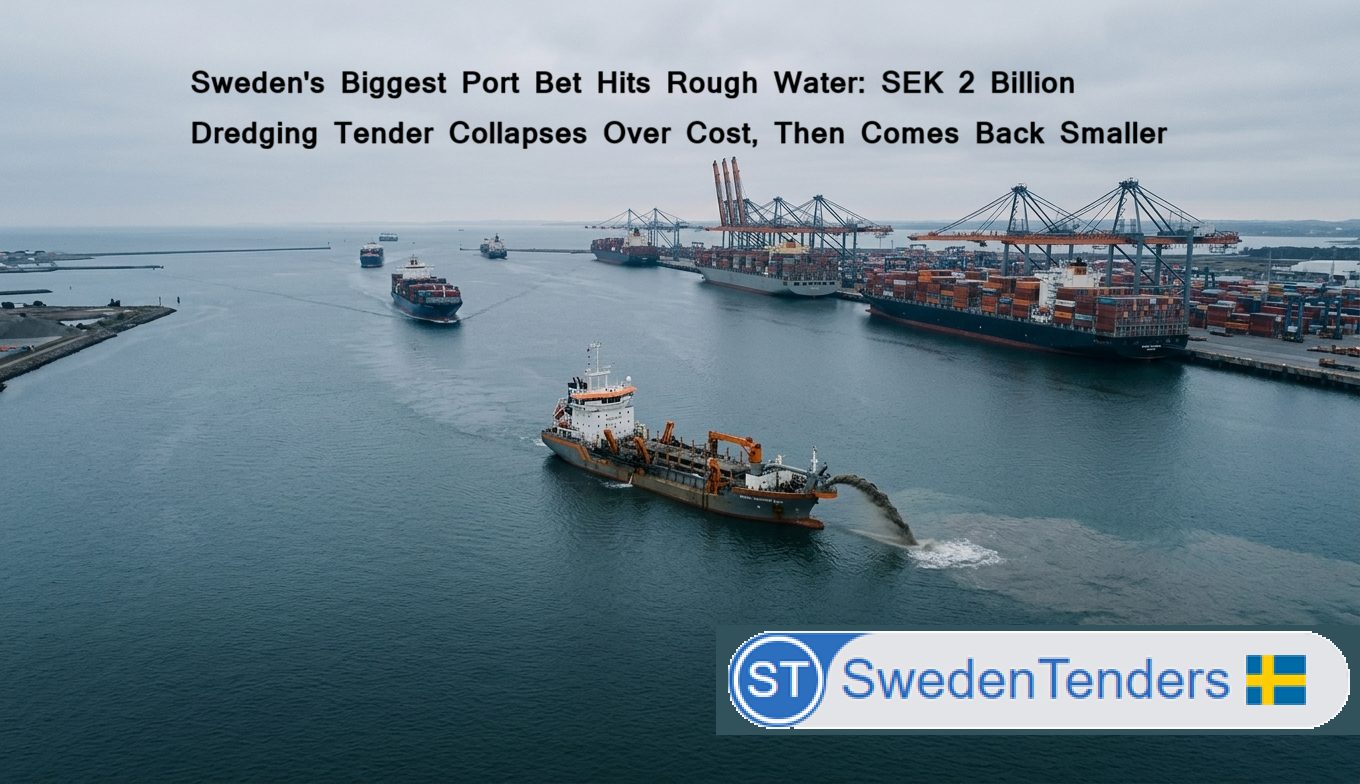
Sweden's Biggest Port Bet Hits Rough Water: SEK 2 Billion Dredging Tender Collapses Over Cost, Then Comes Back Smaller
Standfirst:
The Swedish Maritime Administration set out to dredge a deeper channel into the Port of Gothenburg, Scandinavia's only gateway for the world's largest container ships, through a tender valued at up to SEK 2 billion (roughly €180 million). No contractor was selected. The buyer walked away, citing insufficient funds. What happened next tells a sharper story about cost inflation in European marine works than the notice itself ever could.
Introduction
Gothenburg's port sits at an odd disadvantage for a facility that calls itself Scandinavia's only true gateway to the world's largest cargo ships. The fairway leading into it is too shallow. Container vessels over 400 metres long, capable of carrying more than 20,000 boxes, have had to arrive half empty because the channel simply cannot take their full draft. Fixing that has been a national infrastructure priority since 2019, backed jointly by the Swedish Maritime Administration, the Swedish Transport Administration and the Port of Gothenburg.
In late 2025, the Maritime Administration and the port authority jointly floated a tender to dredge and blast roughly eight million cubic metres of material from the approach channel, known as Torshamnsleden, at an estimated cost of up to SEK 2 billion. Three contractors submitted bids. None was selected. The reason given in the official award notice is blunt: the buyer decided the project could not proceed because of insufficient funds.
Why This Contract Matters
This is not a story about a contract changing hands, it is a story about one not changing hands and why that matters more. Public buyers cancelling major infrastructure tenders on cost grounds has become a recurring theme across Europe's marine and civil works sector, as inflation in fuel, steel, vessel charter rates and specialist dredging capacity has pushed bid prices well above the budgets set years earlier when projects were first costed.
For Gothenburg, the stakes are strategic rather than merely operational. Roughly 30% of Sweden's foreign trade moves through this port and it is the only Swedish facility capable of receiving the largest transoceanic vessels at all, even if, until now, not fully loaded. A stalled dredging programme does not just delay an engineering project; it keeps Swedish exporters and importers paying a competitiveness penalty every time a giant containership has to sail past Gothenburg only partially laden.
Contract Timeline
| Date | Milestone |
|---|---|
| 2019 | Skandiaporten project formally launched by Sjöfartsverket, Trafikverket and the Port of Gothenburg |
| February 2024 | Port of Gothenburg begins quay reinforcement works under the parallel harbour basin contract |
| Late 2025 | Joint dredging tender for the fairway (this notice) receives three bids |
| October 2025 | Procurement cancelled; bids came in above the available budget |
| Early 2026 | Fairway design revised, dredged area narrowed, target depth reduced to 16.5 metres from 17.5 metres |
| 13 15 July 2026 | Award notice confirming the cancelled procurement published in OJ S 134/2026 |
| Autumn 2026 | Quay side dredging and rock excavation expected to begin, per the revised programme |
| 2027 2028 | Fairway dredging by the Swedish Maritime Administration expected to proceed under a scoped contract |
Contract Overview
Sjöfartsverket, Sweden's central government maritime authority, ran an open procedure under Directive 2014/24/EU for works to deepen and widen the Torshamnsleden fairway leading into the Port of Gothenburg. The project, known as Skandiaporten or Skandia Gateway, combined dredging and controlled blasting to remove roughly eight million cubic metres of seabed material.
The tender was a joint procurement between Sjöfartsverket and Göteborgs Hamn AB (Port of Gothenburg Authority), reflecting the split responsibilities in the wider programme: the Maritime Administration manages the fairway itself, while the port company is separately responsible for quay strengthening within the harbour basin. This particular notice covers only the fairway dredging component. Three tenders were received. None was awarded. The buyer closed the competition, citing insufficient funds to proceed at the prices bid.
Key Contract Details
| Field | Detail |
|---|---|
| Contracting authority | Sjöfartsverket (Swedish Maritime Administration) |
| Co procuring entity | Göteborgs Hamn AB (Port of Gothenburg Authority) |
| Title | Muddring av farled till Göteborgs hamn, projekt Skandiaporten |
| CPV codes | 45247100 Construction work for waterways; 45252124 Dredging and pumping works |
| Procedure type | Open procedure |
| Legal basis | Directive 2014/24/EU |
| Estimated value | SEK 2,000,000,000 (approximately €180 million at mid 2026 exchange rates) |
| Award criterion | Price only, lowest total fixed price |
| Planned duration | 1 November 2025 to 30 November 2027, with an option to extend by 12 months |
| Outcome | No winner selected, competition closed due to insufficient funds |
| Tenders received | 3 |
| Complaints/review requests | 0 |
| EU funding | None disclosed |
| GPA coverage | No |
| Review body | Förvaltningsrätten i Linköping (Administrative Court of Linköping) |
| Place of performance | Göteborg, Västra Götalands län (NUTS SE232), Sweden |
Project Scope
The works as originally tendered called for deepening and widening roughly five kilometres of fairway, increasing maximum vessel draft from the current 13.5 metres toward a target in the 16.5 17.5 metre range, depending on the final design. Dredged and blasted material, including a portion of contaminated sediment requiring careful containment, was to be relocated to a designated disposal site west of Vinga, an area long used for this purpose because of its depth and stable, accumulating seabed.
The notice also attached extensive environmental conditions to the works, aimed at reducing pollution during construction: strict requirements on marine fuel sulphur content, minimum shares of renewable energy in vehicle and vessel fuel use, age limits on land based construction machinery and mandatory emissions class standards for heavy vehicles. These conditions were carried into the tender regardless of which contractor eventually wins the rescoped works and they illustrate how far environmental compliance requirements have moved into the technical fabric of Swedish public works contracts, not just their scoring criteria.
About the Contracting Authority
Sjöfartsverket, the Swedish Maritime Administration, is the central government authority responsible for maintaining Sweden's shipping lanes, icebreaking services, pilotage and maritime safety infrastructure. It manages the fairways leading into Swedish ports, including the deepening and widening work at the centre of this notice and adjusts navigational markings and sea safety installations as fairway dimensions change. Its role in Skandiaporten is technical and operational: while the wider project also involves Trafikverket (the Swedish Transport Administration, responsible for needs analysis and state co financing) and the Port of Gothenburg (responsible for quay works), Sjöfartsverket is the entity actually procuring and executing the fairway dredging.
Göteborgs Hamn AB, the Port of Gothenburg Authority, is named in the notice as a joint procuring party. It is Scandinavia's largest port and Sweden's only facility offering direct ocean shipping to Asia and other continents for the largest container vessels. The port company's own quay strengthening works, running in parallel to this fairway contract, began in February 2024 and are being funded and executed separately from the dredging scope covered here.
Förvaltningsrätten i Linköping, the Administrative Court of Linköping, is designated as the review body for any procurement challenges connected to this notice. Its function is purely judicial, it did not participate in the decision to cancel the tender, but its listing gives unsuccessful or aggrieved bidders a defined legal route to contest procurement decisions under Swedish law.
About the Organisations Involved
No contractor was awarded this contract, so there is no winning bidder to profile. The notice does not identify the three companies that submitted tenders and Swedentenders.com is not aware of any public disclosure naming them. What is established, from Sjöfartsverket's own project reporting, is that the bids received in late 2025 exceeded the funds the buyer had available, prompting cancellation rather than negotiation or an award at a higher price.
Procurement Analysis
Sjöfartsverket ran an open procedure, the standard EU wide competitive route for above threshold works contracts, evaluated purely on price, the lowest total fixed bid would have won, with no separate quality or technical scoring weighting recorded in the notice. That single criterion structure is common in large scale dredging and marine works, where technical specifications are usually fixed in the tender documents and price competition is expected to do the sorting.
The critical fact in this notice is the non award justification: "insufficient funds," a decision made by the buyer rather than a failure of the market to produce compliant bids. That distinction matters. It means Sjöfartsverket judged all three tenders technically acceptable but collectively too expensive relative to its budget envelope, a scenario increasingly common in capital intensive marine works, where estimates fixed years earlier at the planning stage have not kept pace with the sharp rise in dredging vessel day rates, marine fuel costs and specialist blasting capacity across Northern Europe.
No complaints were filed against the cancellation and the notice records the review body without any indication of a formal dispute, suggesting the market broadly understood or at least did not contest, the buyer's decision to walk away rather than proceed at inflated cost.
Additional Procurement Facts
Three tenders were received, all for a single, undivided lot; the notice does not break down submissions by SME status. The contract carried no framework agreement and no dynamic purchasing system, this was a conventional one off works contract. It was not covered by the WTO Government Procurement Agreement and no EU funding was attached to the project, meaning the entire cost burden falls on Swedish national infrastructure budgets and the Port of Gothenburg's own resources.
Market & Industry Perspective
Marine dredging and blasting for a project of this scale sits at the top end of a specialised, capital intensive segment of the European civil works market, dominated globally by a small number of large dredging contractors capable of mobilising heavy vessels, cutter suction dredgers and offshore disposal logistics at the multi million cubic metre scale this project demands. The cancellation of this tender is a visible signal to that market: buyers are hitting a ceiling on what they can afford, even for strategically important national infrastructure.
Industry reporting following the cancellation indicates Sjöfartsverket and the Port of Gothenburg responded not by abandoning the project, but by engineering it, narrowing the dredged area and reducing the target depth to 16.5 metres from the original 17.5 metre ambition, while splitting the procurement into separate parts to keep the quay reinforcement schedule on track. That is a textbook example of a public buyer trading scope for affordability rather than accepting a blown budget or scrapping a strategically critical project outright.
Economic Significance
At an estimated SEK 2 billion or roughly €180 million, this was one of the larger marine infrastructure tenders issued in Sweden in the current cycle and its collapse briefly put a genuinely consequential piece of national trade infrastructure in limbo. Nearly a third of Sweden's foreign trade moves through Gothenburg and its status as the only Scandinavian port capable of handling the largest container vessels gives the fairway depth question outsized importance relative to the contract's own value.
The episode is also a useful data point on cost inflation in European marine and dredging works more broadly. A project costed and planned from 2019 onward ran into a bid environment, by late 2025, where market prices for the same physical scope of work had moved beyond what the original budget could absorb, a gap wide enough to force a full redesign rather than a modest renegotiation.
Future Procurement Opportunities
Following the redesign, dredging and quay side rock excavation work is expected to begin in autumn 2026, with the Swedish Maritime Administration's portion of the fairway works, now scoped to a shallower 16.5 metre target depth, with an option to deepen further later, proceeding through 2027 and 2028. That means a new procurement, smaller in dredged volume but still substantial, should be expected to reach the market covering the rescoped fairway works, separate from the quay reinforcement contract the Port of Gothenburg is running on its own timeline.
Contractors that priced the original eight million cubic metre scope should recalibrate their cost models around the reduced dredging volume and revised depth target before the rescoped tender appears. Suppliers of environmental monitoring, sediment containment and low emission marine plant should also expect the same extensive environmental technical requirements, on fuel standards, vessel emissions class and machinery age limits, to reappear largely unchanged in any successor tender.
Opportunities for Suppliers
Even with the original tender cancelled, this project remains very much alive and the market around it has not closed. Contractors specialising in large volume marine dredging, controlled underwater blasting and contaminated sediment disposal should watch for the rescoped fairway tender expected ahead of the autumn 2026 start date. Firms offering compliant low sulphur marine fuel, alkylate petrol, renewable content biofuels or emissions compliant heavy machinery meeting Sweden's Steg (Stage) IIIA/IIIB engine standards have a defined, quantifiable market here, since these requirements are written directly into the technical specification rather than treated as optional scoring criteria.
What Businesses Should Watch
Three signals will indicate how this project moves forward. First, whether Sjöfartsverket issues the rescoped fairway tender on the schedule industry reporting suggests, targeting an autumn 2026 start for quay adjacent works and 2027 2028 for the fairway itself. Second, whether the reduced 16.5 metre depth target holds or whether the retained option to deepen a further metre is exercised, which would reopen a larger dredging scope later in the programme. Third, whether the cost pressures that sank this tender, rising marine fuel, vessel charter and dredging capacity prices across Northern Europe, ease or persist, since that will shape pricing on the next competition and on comparable port deepening tenders elsewhere in the region.
SwedenTenders.com Procurement Intelligence
This notice is a reminder that a "Result" notice in the TED system does not always mean a contract was won, sometimes it documents the opposite and that is often the more informative outcome for the market to study. Cancellations on cost grounds are becoming a visible pattern in large European marine and civil works procurement, driven by a widening gap between budgets fixed years in advance and bid prices shaped by real time input costs in fuel, vessel charter and specialist labour.
What sets this case apart is the buyer's response. Rather than tendering the identical scope and hoping for lower bids or scrapping the project, Sjöfartsverket and the Port of Gothenburg engineered the physical scope itself, reducing depth and dredged volume, to bring the project back within budget while preserving the strategic objective of giving Gothenburg deeper draft capacity. For suppliers watching European port infrastructure, this is the more replicable playbook going forward: expect buyers facing blown budgets to redesign rather than default and to split large contracts into smaller, more financeable parts rather than accept a single oversized, harder to fund package.
The broader trend to track is how frequently environmental technical specifications, fuel standards, machinery emissions classes, vehicle age limits, are now embedded as binding contract conditions in Nordic public works, rather than appearing only as scored, optional criteria. Contractors who cannot demonstrate compliance with these standards may find themselves excluded from tendering at all, regardless of price competitiveness.
Supplier Takeaways
- A "no winner" result in a TED notice can reflect budget driven cancellation rather than a failed competition, check the non award justification field before assuming the project has ended.
- Sjöfartsverket and the Port of Gothenburg have already shown they will redesign scope rather than abandon a strategically important project when bids exceed budget.
- Expect a rescoped fairway dredging tender ahead of the planned autumn 2026 start, sized to a reduced 16.5 metre depth target rather than the original 17.5 metre ambition.
- Environmental technical requirements, marine fuel sulphur limits, renewable energy content, vehicle emissions class, machinery age caps, are binding specifications in this programme, not optional scoring add ons.
- Price only award criteria mean cost discipline, not technical differentiation, will likely decide the rescoped competition.
Key Takeaways
- Sjöfartsverket's SEK 2 billion tender to dredge the Gothenburg fairway received three bids but was cancelled due to insufficient funds.
- The project, known as Skandiaporten, aims to deepen the channel into Sweden's only port capable of receiving the world's largest container ships at full draft.
- Following cancellation, the fairway design was revised to a shallower 16.5 metre target depth to bring costs back within budget.
- A rescoped tender covering the reduced fairway works is expected ahead of an autumn 2026 construction start.
- The contract carries no EU funding and is not covered by the Government Procurement Agreement; it is financed through Swedish national and port authority budgets.
Conclusion
A cancelled tender rarely makes for as clean a headline as a signed contract, but this one carries more useful intelligence than most award stories. It shows a European infrastructure buyer confronting a real budget ceiling, refusing to either overpay or abandon a strategically important project and instead redesigning the physical scope of the work to fit the money available. For contractors watching the Nordic marine works market, the lesson is straightforward: pricing discipline now and flexibility to bid on a rescoped, smaller version of a familiar project later, will matter more than being first to bid on the original, over ambitious scope.
Frequently Asked Questions
Why was no contractor selected for this contract?
Sjöfartsverket cancelled the procurement because the bids received exceeded the funds available for the project, a decision the notice records as a buyer choice due to insufficient funds, not a lack of qualified bidders.
How many companies bid for the contract?
Three tenders were submitted.
What was the estimated value of the contract?
Up to SEK 2,000,000,000, roughly €180 million at exchange rates prevailing in mid 2026.
Is the project cancelled permanently?
No. Industry reporting indicates the Swedish Maritime Administration and the Port of Gothenburg redesigned the fairway to a reduced depth target and split the procurement into smaller parts, with dredging and rock excavation works expected to begin in autumn 2026.
What is Skandiaporten?
It is the joint project name for deepening and widening the fairway into the Port of Gothenburg and strengthening its container quays, run in partnership between Sjöfartsverket, Trafikverket and Göteborgs Hamn AB.
Was any EU funding involved?
No. The notice confirms the project was not financed with EU funds.
Which court handles disputes over this procurement?
Förvaltningsrätten i Linköping, the Administrative Court of Linköping, is named as the review organisation.
Why does the depth of the fairway matter economically?
Roughly 30% of Sweden's foreign trade moves through the Port of Gothenburg, the only Scandinavian port able to receive the largest container vessels, though currently only if they sail partially loaded, since the existing channel depth cannot support their full draft.
Source: EU Official Journal, Contract Award Notice 489878-2026, OJ S 134/2026, published 15/07/2026. Contracting authority: Sjöfartsverket.

Fresh and verified Tenders from Sweden. Find, search and filter Tenders/Call for bids/RFIs/RFPs/RFQs/Auctions published by the government, public sector undertakings (PSUs) and private entities.
- 1,000+ Tenders
- Verified Tenders Only
- New Tenders Every Day
- Tenders Result Data
- Archive & Historical Tenders Access
- Consultants for RFI/RFP/RFQ
- Tender Notifications & Alerts
- Search, Sort, and Filter Tenders
- Bidding Assistance & Consulting
- Customer Support
- Publish your Tenders
- Export data to Excel
- API for Tender Data
- Tender Documents

Fill out the form below and you will receive a call from us within 24 hours.
Get FREE SAMPLE TENDERS from Sweden in your email inbox.
Copyright © 2014-2026 SwedenTenders.com. All Rights Reserved.