Sweden Awards Framework Contract for Heavy-Duty Truck and Trailer Procurement
24 Jul 2026
Introduction: Hässleholm Miljö AB has awarded a framework contract for the supply of heavy duty transport vehicles to strengthen its operational fleet supporting municipal environmental and waste management services. Published in the Official Journal of the European Union (OJ S 141/2026), the procurement covers the acquisition of a hook lift truck, a hook lift trailer and a hook lift tank designed for demanding transport operations. The contract was awarded following an open procurement procedure and forms part of Hässleholm Miljö AB's ongoing investment in modern, environmentally responsible transport equipment. The estimated procurement value was SEK 10 million excluding VAT, while the awarded framework agreement has an approximate value of SEK 6.297 million. The framework agreement will run from 14 July 2026 to 13 July 2027. The successful supplier, Göinge Bil Lastvagnar Aktiebolag, will provide specialised transport equipment including one hook lift truck, one hook lift trailer and one hook lift tank. These vehicles are expected to support waste collection, material transportation and other municipal operational activities requiring flexible heavy duty transport solutions. The procurement also reflects Sweden's continued focus on sustainable public purchasing. According to the contract notice, environmental considerations formed part of the strategic procurement objectives, with the contracting authority aiming to reduce environmental impacts through climate change mitigation and pollution prevention measures when selecting the supplier. Why This Contract Matters Municipal environmental companies depend on reliable heavy duty vehicles to deliver essential public services including waste management, recycling, transport of containers and environmental maintenance activities. Procuring modern transport equipment enables public organisations to improve operational efficiency while supporting long term sustainability objectives. The contract demonstrates how Swedish public authorities increasingly integrate environmental considerations into procurement decisions. Rather than focusing solely on purchase price, the contracting authority incorporated strategic procurement objectives aimed at reducing environmental impacts, reflecting broader national and European sustainability policies. The framework agreement structure also provides procurement flexibility by allowing future purchases through reopening of competition during the agreement period. This enables Hässleholm Miljö AB to respond to operational requirements while maintaining competitive procurement practices throughout the contract duration. As municipalities continue modernising vehicle fleets to meet environmental targets and operational demands, similar procurements for specialised trucks, trailers and transport equipment are expected to remain an important segment of Sweden's public procurement market. Contract Timeline Milestone Details Country Sweden Notice Type Contract Award Notice - Standard Regime Publication OJ S 141/2026 - 24 July 2026 Contracting Authority Hässleholm Miljö AB Procedure Open Procedure Contract Type Supplies Main CPV 34130000 - Motor vehicles for the transport of goods Estimated Procurement Value SEK 10,000,000 excluding VAT Framework Agreement Value Approximately SEK 6,297,000 Winner Selected 3 July 2026 Contract Signed 14 July 2026 Framework Duration 14 July 2026 - 13 July 2027 Contract Overview The procurement covers the supply of specialised heavy duty transport equipment consisting of one hook lift truck, one hook lift trailer and one hook lift tank. These vehicles are intended to strengthen Hässleholm Miljö AB's operational fleet used for municipal environmental and transport activities. The contract was awarded through an open procurement procedure under Directive 2014/24/EU. The procurement is structured as a framework agreement with reopening of competition, allowing future purchases to be made under the framework in accordance with procurement regulations. The project is not financed through European Union funds and is covered by the Government Procurement Agreement (GPA). Environmental sustainability played an important role during procurement planning. The published notice states that the contracting authority sought to reduce environmental impacts through climate change mitigation and pollution prevention measures, highlighting Sweden's commitment to integrating sustainability objectives into public purchasing. Key Contract Details Item Information Project Title Truck with Trailer in Various Configurations Contracting Authority Hässleholm Miljö AB Country Sweden Main CPV 34130000 - Motor vehicles for the transport of goods Estimated Procurement Value SEK 10,000,000 excluding VAT Framework Agreement Value Approximately SEK 6,297,000 Procurement Procedure Open Procedure Framework Agreement Yes - With reopening of competition Contract Period 14 July 2026 - 13 July 2027 EU Funding Not financed through European Union funds Project Scope The procurement covers the supply of specialised heavy duty transport equipment for Hässleholm Miljö AB. According to the published procurement notice, the contract includes the delivery of one hook lift truck, one hook lift trailer and one hook lift tank. These vehicles are intended to support the organisation's operational requirements for transporting waste containers and carrying out municipal environmental services. The contract has been structured as a framework agreement with reopening of competition, allowing the contracting authority flexibility to procure under the framework during its validity period. The agreement runs from 14 July 2026 to 13 July 2027 and supports the authority's objective of maintaining a reliable, modern and environmentally responsible transport fleet. In addition to supplying the required vehicles, contractors were expected to meet the technical specifications outlined in the procurement documentation. The contracting authority also incorporated strategic environmental objectives into the procurement, encouraging solutions that contribute to climate change mitigation and pollution prevention. Supply of one hook lift truck. Supply of one hook lift trailer. Supply of one hook lift tank. Delivery under a framework agreement with reopening of competition. Support for municipal transport and environmental operations. Compliance with technical and environmental procurement requirements. About the Contracting Authority Hässleholm Miljö AB is a Swedish public undertaking controlled by a local authority and operates within the field of general public services. The organisation is responsible for delivering environmental and municipal services, including activities that require specialised transport equipment for waste management and related operational tasks. To maintain efficient public services, the organisation regularly invests in modern equipment and infrastructure. This procurement forms part of its fleet renewal strategy, ensuring that operational vehicles remain capable of meeting current service demands while supporting environmental sustainability objectives. The procurement was conducted through an electronic open procedure in accordance with the provisions of Directive 2014/24/EU, ensuring transparent competition among qualified suppliers. Organisations Involved Hässleholm Miljö AB acted as the contracting authority responsible for preparing the procurement, evaluating tenders and awarding the framework agreement. The procurement notice identifies Förvaltningsrätten i Malmö as the review organisation responsible for handling procurement appeals and providing additional information relating to review procedures. The contract was awarded to Göinge Bil Lastvagnar Aktiebolag, while Börjessons Lastbilar Aktiebolag participated in the competition as the unsuccessful tenderer. Winning Supplier The framework agreement was awarded to Göinge Bil Lastvagnar Aktiebolag, a medium sized Swedish supplier specialising in commercial vehicles and heavy transport equipment. According to the contract award notice, the supplier was selected on 3 July 2026 and the framework agreement was formally concluded on 14 July 2026. The published notice indicates that subcontracting arrangements were not yet known at the time of publication. The awarded supplier will provide the specialised transport equipment required by Hässleholm Miljö AB under the framework agreement during its one year duration. Contract Award Details Item Details Winning Supplier Göinge Bil Lastvagnar Aktiebolag Framework Agreement Value Approximately SEK 6,297,000 Estimated Procurement Value SEK 10,000,000 excluding VAT Total Tenders Received 2 Winner Selected 3 July 2026 Contract Signed 14 July 2026 Framework Agreement Yes - With reopening of competition Subcontracting Not yet known. Procurement Analysis The procurement reflects Hässleholm Miljö AB's strategy of maintaining a modern fleet capable of supporting municipal environmental and waste management operations. Instead of purchasing standard commercial vehicles, the contracting authority sought specialised equipment designed to handle demanding transport tasks associated with waste collection and container handling. The contract was awarded through an open procurement procedure under Directive 2014/24/EU, providing qualified suppliers with an equal opportunity to compete. Two tenders were received during the competition, with Göinge Bil Lastvagnar Aktiebolag emerging as the successful supplier following the evaluation process. The procurement has been established as a framework agreement with reopening of competition, giving the contracting authority procurement flexibility during the agreement period. This approach enables future purchases under predefined contractual conditions while maintaining competitive procurement practices where required. Another notable feature of the procurement is its emphasis on environmental sustainability. The contracting authority specifically identified the reduction of environmental impacts as a strategic procurement objective, supporting climate change mitigation and pollution prevention alongside operational efficiency. Technical Highlights The framework agreement covers the supply of specialised heavy duty transport equipment intended for municipal operational use. The procurement includes vehicles designed to improve efficiency, reliability and flexibility across environmental service operations. Supply of one hook lift truck. Supply of one hook lift trailer. Supply of one hook lift tank. Heavy duty transport equipment designed for municipal environmental operations. Framework agreement with reopening of competition. One year implementation period from 14 July 2026 to 13 July 2027. Environmental objectives supporting climate change mitigation and pollution prevention. The procurement combines operational performance with sustainability objectives, demonstrating how vehicle procurement increasingly supports broader environmental policies within the public sector. Market & Industry Perspective Across Europe, municipalities continue investing in specialised transport fleets to improve the delivery of environmental and waste management services. Demand for modern heavy duty vehicles has increased as local authorities seek equipment capable of supporting operational efficiency while complying with evolving environmental standards. Framework agreements have become an increasingly common procurement model for vehicle acquisitions because they provide flexibility, reduce administrative workload and enable authorities to respond quickly to operational requirements during the contract period. The inclusion of sustainability objectives within this procurement also reflects broader European procurement trends, where environmental performance is becoming an important consideration alongside technical capability and commercial value. Manufacturers and suppliers offering cleaner, more efficient transport solutions are likely to remain well positioned in future public sector competitions. Economic Significance With an estimated procurement value of SEK 10 million excluding VAT and an approximate framework agreement value of SEK 6.297 million, the contract represents a significant investment in municipal transport infrastructure. Beyond supplying vehicles, the procurement supports Sweden's commercial vehicle sector by creating opportunities for manufacturers, authorised dealers and specialised transport equipment providers. Investments of this nature also contribute to the long term reliability of essential public services by ensuring municipalities have access to modern operational equipment. Although the procurement is not financed through European Union funds, it aligns with wider public sector objectives of improving operational efficiency while reducing environmental impacts through sustainable procurement practices. Additional Procurement Facts Country: Sweden. Contracting authority: Hässleholm Miljö AB. Main CPV: 34130000 - Motor vehicles for the transport of goods. Estimated procurement value: SEK 10,000,000 excluding VAT. Approximate framework agreement value: SEK 6,297,000. Procurement procedure: Open procedure. Framework agreement: Yes - with reopening of competition. Procurement is covered by the Government Procurement Agreement (GPA). Project is not financed through European Union funds. Total tenders received: 2. Winning supplier: Göinge Bil Lastvagnar Aktiebolag. Strategic procurement objective: Reduction of environmental impacts through climate change mitigation and pollution prevention. Future Procurement Opportunities The award of this framework agreement demonstrates Hässleholm Miljö AB's continued investment in maintaining a modern and efficient fleet for municipal environmental services. As public sector transport requirements evolve, additional procurement opportunities may emerge for heavy duty vehicles, specialised trailers, container handling equipment, maintenance services, spare parts, fleet management solutions and environmentally efficient transport technologies. Municipal authorities across Sweden continue to modernise vehicle fleets to improve operational performance while reducing environmental impacts. Future procurements are therefore expected to include low emission commercial vehicles, intelligent fleet monitoring systems, alternative fuel technologies and equipment designed to support sustainable waste management operations. Opportunities for Suppliers This procurement highlights ongoing demand for suppliers capable of delivering specialised commercial vehicles tailored to public sector operational requirements. Manufacturers, authorised dealers and system integrators offering reliable heavy duty transport equipment remain well positioned to compete for similar municipal contracts. The procurement also demonstrates the growing importance of environmental performance in vehicle purchasing. Suppliers that can offer fuel efficient vehicles, reduced emissions, innovative transport solutions and strong after sales support are likely to gain a competitive advantage in future public procurements. Companies providing maintenance services, fleet optimisation technologies, telematics, vehicle safety systems and lifecycle support may also benefit from increasing investment in municipal transport infrastructure. What Businesses Should Watch Upcoming municipal procurements for heavy duty trucks and specialised transport equipment. Framework agreements covering commercial vehicle supply across Sweden. Growing demand for environmentally sustainable fleet solutions. Public sector investments in waste management and environmental services. Procurements involving climate friendly transport technologies and fleet modernisation. Opportunities for maintenance, servicing and lifecycle support contracts. SwedenTenders.com Procurement Intelligence This procurement illustrates how Swedish public authorities are combining operational efficiency with sustainability objectives when purchasing specialised transport equipment. Rather than focusing solely on vehicle acquisition, Hässleholm Miljö AB incorporated environmental considerations into its procurement strategy, supporting broader climate and pollution reduction goals. The use of a framework agreement with reopening of competition provides additional flexibility for future purchasing while maintaining transparency and competition throughout the agreement period. Such procurement models have become increasingly common for vehicle acquisitions because they simplify purchasing while allowing authorities to respond to changing operational requirements. The project also reflects the continued demand for specialised heavy duty transport equipment within municipal services. As local authorities modernise ageing fleets and strengthen environmental performance, suppliers capable of delivering high quality commercial vehicles with strong technical support will continue to find attractive opportunities in Sweden's public procurement market. Supplier Takeaways The framework agreement was awarded to Göinge Bil Lastvagnar Aktiebolag. The approximate framework agreement value is SEK 6,297,000. The agreement remains valid from 14 July 2026 to 13 July 2027. The procurement covers one hook lift truck, one hook lift trailer and one hook lift tank. The framework agreement allows reopening of competition during its validity period. Environmental sustainability formed an important strategic procurement objective. Key Takeaways Hässleholm Miljö AB has strengthened its operational transport fleet through a specialised vehicle procurement. The procurement was conducted through an open procedure under Directive 2014/24/EU. Göinge Bil Lastvagnar Aktiebolag secured the framework agreement following a competitive tender process. The procurement supports municipal environmental and waste management operations. Climate change mitigation and pollution prevention were incorporated into the procurement strategy. The framework agreement provides procurement flexibility while ensuring continued competition for future purchases. Conclusion The framework agreement awarded by Hässleholm Miljö AB represents an important investment in modern transport infrastructure supporting Sweden's municipal environmental services. By procuring specialised heavy duty vehicles through a competitive procurement process, the organisation aims to improve operational reliability while advancing its sustainability objectives. The contract also demonstrates broader procurement trends within Europe's public sector, where environmental performance, operational efficiency and long term procurement flexibility increasingly influence purchasing decisions. As municipalities continue modernising vehicle fleets and strengthening environmental commitments, similar procurements are expected to create significant opportunities for commercial vehicle manufacturers and transport equipment suppliers. Source: TED European Union, Contract Award Notice, OJ S 141/2026, Notice 514040-2026. published 24/07/2026. Contracting authority: Hässleholm Miljö AB.
View Details
Three Swedish Regions, Eleven Suppliers, One Goal: Keeping Visually Impaired Residents Reading, Working and Living Independently
23 Jul 2026
StandfirstRegion Halland, Region Blekinge and Region Skåne have jointly awarded a framework agreement covering everything from spectacle lenses and contact lenses to illuminated magnifiers and telescopic low vision aids, splitting eleven distinct product categories among six suppliers. The framework, with a combined ceiling of SEK 457.6 million, is a quiet but essential piece of Swedish healthcare infrastructure: it is what actually gets a magnifier, a corrective lens or a low vision aid into the hands of a patient who needs one.IntroductionVision loss rarely arrives as a single, simple problem with a single, simple fix. Some patients need standard corrective lenses. Others need high magnification reading glasses, tinted filter lenses for light sensitivity, therapeutic contact lenses for a damaged cornea or, for more severe low vision, illuminated magnifiers, telescopic "binocular" spectacles or battery powered LED loupe systems that let someone with significant sight loss still read a prescription label or a bank statement. Three southern Swedish regions have just secured the supply chain for all of it at once.Region Halland, Region Blekinge and Region Skåne ran a joint procurement, a "samupphandling" in Swedish administrative terms, splitting their combined requirement for spectacle lenses, contact lenses and magnifying aids into eleven separate product category lots. Six suppliers emerged as winners across those eleven lots, from large multinational eye care names like Bausch & Lomb to smaller, low vision specialists like LVI Low Vision International, based in the Swedish town of Växjö.Why This Contract MattersOptical aids of this kind are not a discretionary purchase for the patients who rely on them. A therapeutic contact lens for a damaged cornea or a strong illuminated magnifier for someone with advanced macular degeneration, is often the difference between managing daily life independently and needing constant assistance. Sweden's regional health systems provide many of these aids through dedicated low vision and "syncentral" (vision centre) services and this framework is the procurement mechanism that keeps that service supplied, consistently and at negotiated pricing, across three regions simultaneously.Joint procurement of this kind also matters for the regions themselves. Halland, Blekinge and Skåne are of very different scale and combining their purchasing power into a single framework gives all three access to more competitive supplier terms and a broader range of qualified suppliers per product category, than any one region could realistically negotiate alone, particularly for the more specialised, lower volume categories like telescopic spectacles or standing illuminated magnifiers.Contract Timeline Date Milestone --- Open procedure launched across all 11 lots 26 May 2026 Winners selected across all 11 lots 26 May 2026 Contracts concluded with all winning suppliers 22 July 2026 Award notice dispatched to the EU Publications Office 23 July 2026 Notice published in OJ S 140/2026 Contract OverviewRegion Halland led a joint procurement on behalf of itself, Region Blekinge and Region Skåne, running an open procedure across eleven lots covering distinct categories of spectacle lenses, contact lenses and magnifying and low vision aids. Each lot was evaluated using an identical methodology: bids were assessed as the most economically advantageous for the participating regions based on which tender achieved the lowest comparison value under a combined price and functional evaluation, described in the notice as a 70% quality / 70% price weighting structure set out in the tender's own pricing appendix.Framework agreements were awarded across all eleven lots without reopening of competition, meaning each region can call off supplies directly from the awarded suppliers in each product category without running a further competitive step. Six different suppliers won at least one lot: Multilens AB and Eschenbach Optik GmbH were the two most successful, each winning five lots; Bausch & Lomb Nordic AB and ExpertOptik i Skandinavien AB each won two; and Optileks AB and LVI Low Vision International AB each won one.Key Contract Details Field Detail Lead contracting authority Region Halland Joint buyers Region Blekinge, Region Skåne Title Glasögonglas, kontaktlinser och förstoringsglas CPV code 38624000 - Optical aids (plus 33734200 - Glass for spectacles, 33734000 - Spectacles, 33731000 – Contact lenses) Procedure type Open Legal basis Directive 2014/24/EU Estimated value (full procurement, excl. VAT) SEK 32,000,000 Maximum value of all framework agreements in this notice SEK 457,600,000 (approximately €40 million) Approximate (estimated) value of all framework agreements SEK 352,000,000 (approximately €31 million) Number of lots 11, covering spectacle lenses, contact lenses and magnifying/low vision aids Award criteria Most economically advantageous tender, lowest comparison value under combined price and functional evaluation (70% quality / 70% price, per tender documentation) Framework structure Framework agreement, without reopening of competition Contract renewals Up to 2 renewals per lot EU funding None, not financed with EU funds GPA coverage Yes Strategic procurement aim None recorded Review body Förvaltningsrätten i Göteborg (Administrative Court of Gothenburg) Place of performance Hallands län and the wider participating regions, Sweden Lot by lot results Lot Product Category Winner(s) Tenders Received 1 Spectacle lenses Optileks AB; Multilens AB 2 2 High addition reading glasses Multilens AB 1 3 Filter (tinted) glasses Multilens AB 1 4 Vision correcting contact lenses Multilens AB; ExpertOptik i Skandinavien AB; Bausch & Lomb Nordic AB 3 5 Therapeutic contact lenses Multilens AB; ExpertOptik i Skandinavien AB; Bausch & Lomb Nordic AB 3 6 Battery powered LED loupe systems Eschenbach Optik GmbH 2 7 Telescopic (binocular) spectacles Eschenbach Optik GmbH 1 8 Lamp with built in magnifier LVI Low Vision International AB 2 9 Illuminated magnifier Eschenbach Optik GmbH 2 10 Standing illuminated magnifier Eschenbach Optik GmbH 2 11 Illuminated Visolett magnifier Eschenbach Optik GmbH 1 Project ScopeThe eleven lots together cover the full range of optical aids a regional vision rehabilitation service typically provides: standard and high addition corrective spectacle lenses, tinted filter lenses for light sensitivity, vision correcting and therapeutic contact lenses and a full range of low vision magnification devices, from simple illuminated magnifiers through to telescopic "binocular" spectacles and battery powered LED loupe systems designed for patients with more severe vision impairment. This breadth reflects how varied the clinical need for optical aids genuinely is, spanning routine vision correction through to devices designed specifically for patients with significant, permanent vision loss.About the Contracting AuthorityRegion Halland, based in Halmstad, led this joint procurement on behalf of itself and two neighbouring regions, Region Blekinge and Region Skåne, reflecting a well established pattern of Swedish regional health authorities pooling procurement for recurring clinical supply categories. Optical aids of this kind are typically distributed through regional low vision and vision rehabilitation services, supporting patients whose vision cannot be fully corrected through standard eyewear alone.About the Organisations InvolvedMultilens AB, Winning Tenderer (Lots 1–5)Multilens, based in Mölnlycke near Gothenburg and classified as a large economic operator, was the most broadly successful supplier in this framework, winning or sharing five of the eleven lots, spanning standard spectacle lenses, high addition reading glasses, filter glasses and both vision correcting and therapeutic contact lenses. Its consistent presence across the framework's spectacle and contact lens categories reflects an established position as a major Swedish optical supplies distributor to the public health sector.Eschenbach Optik GmbH, Winning Tenderer (Lots 6, 7, 9, 10 & 11)Eschenbach Optik, a German low vision and magnification specialist manufacturer with a listed Danish operating address in this notice, won five of the eleven lots, the full range of the framework's magnification and telescopic aid categories, including LED loupe systems, telescopic spectacles and multiple illuminated magnifier formats. Eschenbach's dominance of this specific segment reflects its position as one of Europe's leading specialist manufacturers of low vision magnification devices, a category requiring more specialised design and manufacturing capability than standard corrective eyewear.Bausch & Lomb Nordic AB, Winning Tenderer (Lots 4 & 5)The Nordic subsidiary of Bausch & Lomb, one of the world's largest eye care and contact lens manufacturers, won both of the framework's contact lens categories alongside Multilens and ExpertOptik, reflecting the multi winner structure applied to these two lots. Based in Stockholm and classified as a large economic operator listed on a regulated market, Bausch & Lomb's participation brings a globally established contact lens manufacturing pedigree to this specific segment of the framework.ExpertOptik i Skandinavien AB, Winning Tenderer (Lots 4 & 5)Based in Varberg, within Region Halland itself, ExpertOptik won both contact lens categories alongside Multilens and Bausch & Lomb Nordic, giving the lead contracting region a locally based winning supplier within its own borders.Optileks Aktiebolag, Winning Tenderer (Lot 1)A smaller Swedish supplier based in Rättvik, in Dalarna, Optileks won a share of the standard spectacle lens category alongside Multilens, reflecting how even the framework's highest volume, most competitive lot preserved room for a smaller regional specialist to win alongside a larger established distributor.LVI Low Vision International Aktiebolag, Winning Tenderer (Lot 8)Based in Växjö and classified as a micro, small or medium sized enterprise, LVI Low Vision International won the lamp with built in magnifier category, beating fellow bidder Eschenbach Optik in this specific lot, a notable result given Eschenbach's dominance across the framework's other magnification categories and a sign of genuine, product specific competition within the low vision aid segment rather than one supplier sweeping every related category uncontested.Förvaltningsrätten i Göteborg, Review OrganisationThe Administrative Court of Gothenburg is the designated review body for this procurement, providing the formal legal channel through which any bidder wishing to contest an award across any of the eleven lots could do so.Procurement AnalysisRunning a single joint procedure across eleven lots, rather than issuing separate tenders per region or per product category, reflects a deliberate administrative efficiency choice consistent with how Swedish regional health authorities frequently structure recurring clinical supply procurement. The award methodology, assessing bids against a "lowest comparison value" combining price and functional evaluation, allowed each lot to be judged on criteria specific to its own product category, since a spectacle lens and a battery powered LED loupe system require entirely different technical and functional assessment.The competitive pattern across the eleven lots is informative in its own right. The framework's higher volume categories, standard spectacle lenses and both contact lens categories, each drew multiple winning suppliers sharing the lot, suggesting the regions structured these categories to preserve ongoing supplier choice for higher demand products rather than consolidating around a single winner. By contrast, most of the framework's more specialised magnification and low vision aid categories were won outright by a single supplier (predominantly Eschenbach Optik), reflecting a narrower field of manufacturers capable of competing in these more technically specific niches, with LVI Low Vision International's win in Lot 8 standing out as the one specialised category where a different, smaller Swedish supplier prevailed over Eschenbach.One structural feature of this notice is worth flagging plainly for readers working with the underlying figures: every one of the eleven lots is recorded with an identical maximum framework value of SEK 41,600,000 and an identical estimated value of SEK 32,000,000, regardless of each lot's evidently different real world order volume, a standard spectacle lens category and a standing illuminated magnifier category are very unlikely to generate genuinely equal demand. This appears to reflect a shared administrative ceiling applied uniformly across all eleven lots (consistent with the fact that summing all eleven identical lot level figures produces exactly the notice's own overall totals of SEK 457.6 million and SEK 352 million), rather than a lot by lot data error. Readers should treat the identical per lot figures as a shared framework ceiling structure rather than an indication that each of the eleven, very different product categories is expected to generate equal actual spending.Additional Procurement FactsTender volumes varied meaningfully across the eleven lots, from a single tender received in Lots 2, 3, 7 and 11 up to three tenders received in the two contact lens categories (Lots 4 and 5). Subcontracting status is recorded as "not yet known" for every winning tender across all eleven lots. None of the eleven lots carry EU funding and the framework as a whole is confirmed as covered by the WTO Government Procurement Agreement. No strategic procurement objectives, such as environmental or social criteria, were formally recorded against any lot in this notice.Market & Industry PerspectiveThe optical aids and low vision device market splits fairly clearly into two distinct competitive segments, both reflected in this framework's results. Standard spectacle lenses and contact lenses are served by a broader field of established distributors and manufacturers, Multilens, ExpertOptik, Bausch & Lomb and Optileks among them in this notice, competing on price and product range for high volume, relatively standardised products. Specialised low vision magnification and telescopic aids, by contrast, are served by a narrower field of specialist manufacturers, with Eschenbach Optik's near sweep of this framework's magnification categories reflecting its established position as one of Europe's leading low vision device makers, a segment where technical design specialisation matters more than distribution scale.That a smaller, dedicated Swedish low vision specialist like LVI Low Vision International could still win a specific category against Eschenbach demonstrates that this more specialised segment remains genuinely open to focused competitors, rather than being an uncontestable near monopoly for the largest specialist manufacturer.Economic SignificanceAt a combined maximum framework value of SEK 457.6 million (roughly €40 million) across all eleven lots and a more conservative estimated value of SEK 352 million (roughly €31 million), this is a substantial, multi year commitment supporting vision rehabilitation and optical aid services across three Swedish regions. For the six winning suppliers, the framework provides a secure, recurring revenue channel from three regional health systems simultaneously, with contract renewal options extending the framework's effective duration well beyond its initial term.Future Procurement OpportunitiesWith renewal options available on each lot, the next genuinely open competition across some or all of these eleven product categories may not reach the market again for several years, depending on how Region Halland and its partner regions choose to exercise those renewals. Suppliers not currently represented in this framework, particularly in the more specialised magnification and low vision aid categories currently dominated by Eschenbach Optik, should watch for the framework's eventual tender as their primary route into this specific procurement channel.Opportunities for SuppliersManufacturers and distributors of optical aids and low vision devices not currently party to this framework should note the clear split between its high volume, multi winner categories (spectacle and contact lenses) and its more specialised, often single winner magnification categories. Smaller, specialised suppliers, as LVI Low Vision International's Lot 8 win demonstrates, can successfully compete for specific niche categories within a broader framework dominated by a larger specialist manufacturer, provided their product offers genuine differentiation in that specific category.What Businesses Should WatchThree things are worth tracking from this framework. First, how call off volumes are actually distributed among the multiple winning suppliers in the shared lots (spectacle lenses and both contact lens categories), since the framework's "without reopening of competition" structure means each region can choose which of the co winning suppliers to draw from for a given order. Second, whether Eschenbach Optik's dominance across the magnification and low vision aid categories persists into any future tender or whether more competitors, following LVI Low Vision International's example in Lot 8, begin contesting these categories more actively. Third, whether other Swedish regions beyond Halland, Blekinge and Skåne adopt a similar joint procurement model for optical aids, given the apparent efficiency of combining three regions' purchasing power into a single, structured framework.SwedenTenders.com Procurement IntelligenceThis framework is a clear, practical illustration of how regional joint procurement can serve a genuinely heterogeneous category of clinical supplies, from routine spectacle lenses to highly specialised low vision magnification devices, within a single coordinated structure without forcing every product category into the same competitive dynamic. The higher volume, more standardised categories in this notice preserved multiple winning suppliers, maintaining ongoing choice and competitive tension for the products most patients will actually need; the more specialised magnification categories consolidated around a smaller number of specialist manufacturers, reflecting the genuinely narrower field of companies capable of competing in that segment.The identical per lot framework value figures recorded across all eleven categories are a useful reminder that headline financial figures in multi lot procurement notices do not always represent an itemised, lot by lot allocation of expected spending, sometimes, as appears to be the case here, they reflect a shared administrative ceiling applied uniformly across a framework's constituent parts. Readers analysing multi lot frameworks of this kind should look for this pattern before assuming a notice's per lot figures represent genuine, independently calculated demand estimates for each individual product category.For suppliers, the framework's clearest signal is that specialisation still wins in the low vision aid segment specifically: Eschenbach Optik's near total sweep of the magnification categories, interrupted only by LVI Low Vision International's single, focused win, shows that deep product specialisation in a narrow clinical niche remains a viable and often decisive competitive strategy, even within a large, multi supplier joint regional framework.Supplier Takeaways Joint regional procurement frameworks in Sweden often split high volume, standardised product categories (spectacle and contact lenses) across multiple co winning suppliers, while more specialised categories tend to consolidate around fewer, more specialised manufacturers. Deep product specialisation in a narrow clinical niche, as demonstrated by both Eschenbach Optik and LVI Low Vision International in this framework's magnification categories, remains a viable competitive strategy even against larger, more diversified suppliers. Identical per lot framework value figures across a multi lot notice, as seen here, may reflect a shared administrative ceiling rather than genuine lot specific demand estimates, verify this before drawing conclusions about individual category scale. Multi winner lot structures mean call off order volume for a shared category depends on how participating regions choose to distribute their actual orders among co winning suppliers, not simply on being named a winner. Renewal options built into each lot may delay this framework's next open competition by several years; suppliers not currently included should watch for its eventual tender. Key Takeaways Region Halland, Region Blekinge and Region Skåne jointly awarded an 11 lot framework agreement for spectacle lenses, contact lenses and magnifying/low vision aids, with a combined maximum value of SEK 457.6 million (approximately €40 million). Six suppliers won at least one lot: Multilens AB and Eschenbach Optik GmbH each won five lots; Bausch & Lomb Nordic AB and ExpertOptik i Skandinavien AB each won two; Optileks AB and LVI Low Vision International AB each won one. Higher volume spectacle and contact lens categories were awarded to multiple co winning suppliers, while specialised magnification and low vision aid categories were mostly won outright by a single specialist manufacturer. Every lot in the notice carries an identical maximum framework value figure, reflecting a shared administrative ceiling rather than individually calculated per category demand. The framework carries no EU funding and is covered by the WTO Government Procurement Agreement. ConclusionVision loss takes many forms and this framework's eleven separate product categories are a quiet acknowledgment of that fact, a single procurement built to serve everyone from a patient who simply needs a stronger reading lens to someone relying on a telescopic low vision aid to navigate daily life. Three regions, six suppliers and eleven distinct product categories later, the practical result is straightforward: patients across Halland, Blekinge and Skåne should be able to get the specific optical aid they need, negotiated and secured well before they ever have to ask for it.Source: EU Official Journal, Contract Award Notice 509306-2026, OJ S 140/2026, published 23/07/2026. Contracting authority: Region Halland.
View Details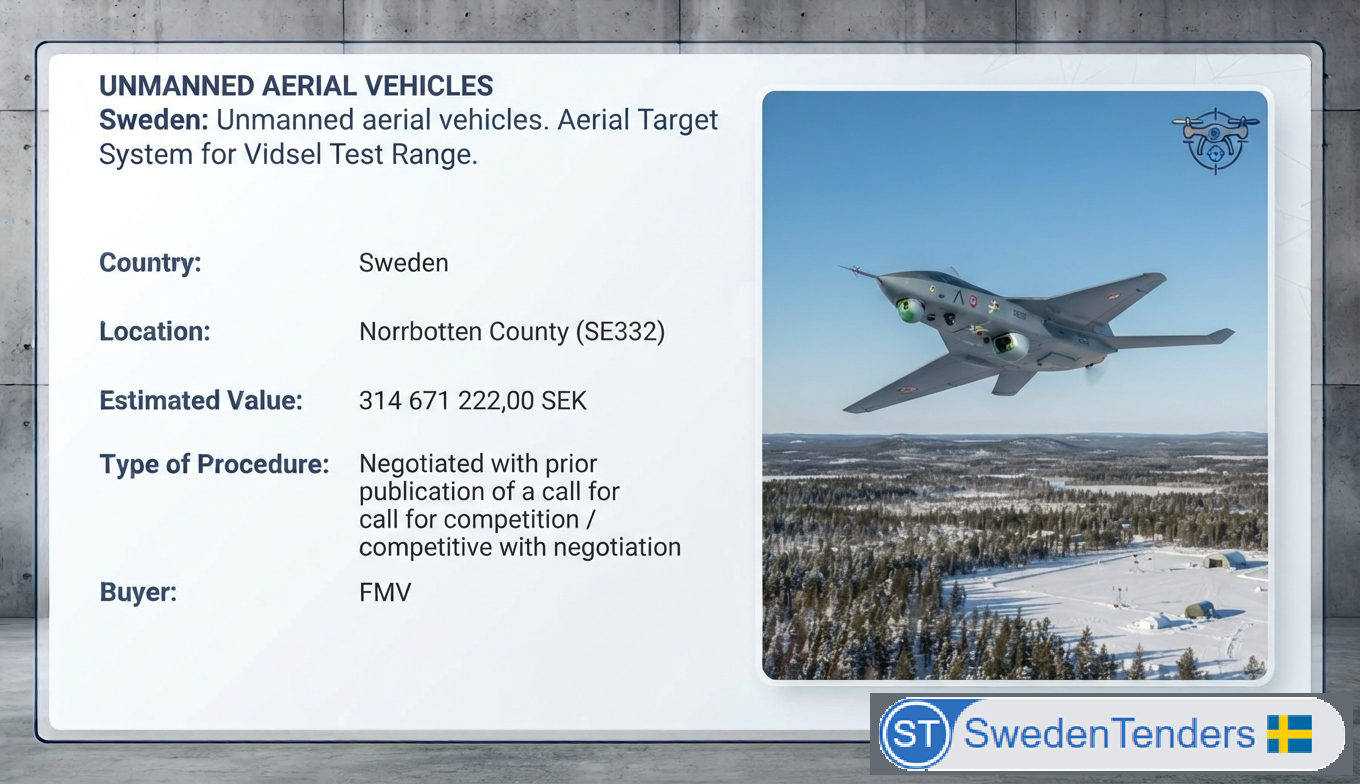
Sweden Awards SEK 314.67 Million Contract for Advanced Aerial Target System at Vidsel Test Range
22 Jul 2026
Standfirst: Sweden's Defence Materiel Administration (FMV) has awarded a contract valued at SEK 314.67 million to Sener Aerospace and Defence (SCR Division) for the supply of an advanced Aerial Target System for the Vidsel Test Range. The procurement also includes a framework agreement with a potential duration of up to ten years, enabling future call off purchases to support Sweden's long term defence testing capabilities. Introduction Modern defence organisations depend on sophisticated testing environments to validate the performance of missile systems, radar technologies, air defence platforms and military aircraft. One of the most important elements of these environments is the availability of realistic aerial target systems that accurately simulate airborne threats during live fire exercises and weapon evaluation programmes. To strengthen these capabilities, Sweden's Försvarets materielverk (FMV), the Swedish Defence Materiel Administration, has completed a major defence procurement for an Aerial Target System for the Vidsel Test Range. Published as TED Contract Award Notice 506171-2026, the procurement covers both the initial acquisition of the aerial target system and a long term framework arrangement supporting future procurements throughout the system's operational lifecycle. The contract has been awarded to Sener Aerospace and Defence (SCR Division), with a total contract value of SEK 314,671,222. According to the contract award notice, the successful supplier will deliver the initial aerial target system while also supporting future requirements through a framework agreement that may remain available for up to ten years. Why This Contract Matters Military test ranges require advanced aerial target systems capable of replicating realistic airborne threats during operational testing and training exercises. These systems enable defence organisations to verify the effectiveness of missile systems, sensors, surveillance technologies and weapon platforms under controlled but realistic operating conditions. The Vidsel Test Range in northern Sweden serves as an important defence testing facility. Procuring an advanced aerial target system strengthens the range's capability to support current and future defence programmes while ensuring long term operational readiness. Unlike a conventional one time equipment purchase, this procurement combines an initial supply contract with a long term framework arrangement. This approach allows FMV to procure additional equipment, upgrades, spare parts or related requirements through future call off purchases without conducting an entirely new procurement procedure each time a requirement arises. Contract Timeline Milestone Details Country Sweden Contracting Authority FMV (Swedish Defence Materiel Administration) Procurement Title Aerial Target System for Vidsel Test Range Procedure Negotiated Procedure with Prior Publication of a Call for Competition Contract Type Supplies Main CPV 35613000 - Unmanned aerial vehicles Estimated Contract Value SEK 314,671,222 Winner Selected 9 March 2026 Contract Signed 3 July 2026 Publication Date 22 July 2026 Contract Overview The procurement covers one supply contract for the acquisition of an aerial target system together with options for the initial delivery and one framework agreement under which future call off purchase orders may be issued according to operational requirements. According to the procurement notice, the same supplier has been awarded both the initial supply contract and the accompanying framework agreement. The framework may remain available for procurement activities for up to ten years, enabling FMV to acquire additional equipment and related requirements on a need basis. The estimated value of the procurement amounts to SEK 314,671,222. The procurement was conducted under Directive 2009/81/EC, which governs defence and security procurement within the European Union. The contract concerns supplies and relates to unmanned aerial vehicles under CPV code 35613000. Key Contract Details Category Information Buyer FMV Country Sweden Contract Type Supplies Procurement Title Aerial Target System for Vidsel Test Range Main CPV 35613000 - Unmanned aerial vehicles Procedure Negotiated Procedure with Prior Publication of a Call for Competition Estimated Contract Value SEK 314,671,222 Supply Contract Yes Framework Agreement Included Yes (up to 10 years for future call off purchases) Contract Performance Period 3 July 2026 – 2 July 2029 Legal Basis Directive 2009/81/EC EU Funding No Project Scope The procurement includes the acquisition of an advanced aerial target system for Sweden's Vidsel Test Range together with options for the initial system delivery. In addition to the supply contract, FMV established a framework arrangement through which future procurement requirements may be fulfilled by issuing call off purchase orders as operational needs arise. The procurement notice does not disclose the detailed technical specifications of the aerial target system. However, it confirms that the procurement concerns unmanned aerial vehicles intended for defence testing activities at the Vidsel Test Range. The contract will support Sweden's defence testing infrastructure by providing equipment required for military evaluation and test programmes while allowing future procurement requirements to be addressed through the associated long term framework agreement. About the Contracting Authority FMV (Försvarets materielverk), the Swedish Defence Materiel Administration, serves as Sweden's central government authority responsible for procuring, developing and supporting defence equipment for the Swedish Armed Forces. Operating under the national defence sector, FMV manages procurement programmes covering military systems, equipment, technology and associated support services. As the contracting authority for this procurement, FMV conducted the competition and will oversee contract implementation while managing future procurement activities under the associated framework arrangement. About the Organisations Involved FMV acted as the contracting authority and also served as the organisation providing additional procurement information throughout the procurement process. Review procedures are handled by Förvaltningsrätten i Stockholm, which also provides additional information regarding review procedures. The successful supplier is Sener Aerospace and Defence (SCR Division), headquartered in Spain. The company was selected on 9 March 2026, with the contract formally concluded on 3 July 2026. The awarded contract has a value of SEK 314,671,222. The procurement attracted competition from several defence technology suppliers. According to the contract award notice, unsuccessful tenderers included AETHER AERONAUTICS SA, QinetiQ Target Systems Ltd/USD, Saab aktiebolag and EXCALIBUR INTERNATIONAL a.s.. A total of five tenders were received during the procurement process.Procurement Analysis The procurement was conducted using the Negotiated Procedure with Prior Publication of a Call for Competition under Directive 2009/81/EC, the European legal framework governing defence and security procurement. This procedure enabled FMV to negotiate with qualified suppliers while ensuring competition for a technologically advanced defence capability. A distinctive feature of this procurement is that it combines two contractual elements within a single competition. First, FMV awarded a supply contract covering the initial acquisition of the aerial target system, including options associated with the initial delivery. Second, the procurement established a framework agreement with a duration of up to ten years, allowing future call off purchase orders to be issued whenever operational requirements arise. According to the notice, the same supplier was awarded both the supply contract and the framework agreement. The procurement concerns unmanned aerial vehicles for the Vidsel Test Range and carries an estimated value of SEK 314,671,222. The contract performance period for the initial supply contract runs from 3 July 2026 until 2 July 2029, while the framework agreement provides a mechanism for future procurement activities beyond the initial delivery. The contract was awarded using the lowest price criterion. The procurement notice specifies that the successful tender had to satisfy all mandatory requirements and offer the lowest evaluated price. The total evaluated price was determined using five predefined pricing scenarios described in the procurement documentation. The procurement was not financed through European Union funds and was not identified as strategic procurement in the contract award notice. A total of five tenders were submitted, demonstrating competitive participation from international defence suppliers specialising in aerial target systems and unmanned aircraft technologies. Additional Procurement Facts Item Details Contracting Authority FMV Country Sweden Procedure Negotiated Procedure with Prior Publication of a Call for Competition Contract Type Supplies Main CPV 35613000 – Unmanned aerial vehicles Estimated Contract Value SEK 314,671,222 Framework Arrangement Included for up to 10 years of future call off purchases Supply Contract Period 3 July 2026 – 2 July 2029 Award Criterion Lowest evaluated price Number of Tenders Received 5 Legal Basis Directive 2009/81/EC EU Funding No Strategic Procurement No strategic procurement Market and Industry Perspective The procurement demonstrates continued investment in advanced defence testing infrastructure across Europe. Modern armed forces increasingly require sophisticated aerial target systems capable of supporting the testing and evaluation of missiles, air defence systems, radar technologies and other military capabilities under realistic operational conditions. Combining an initial acquisition with a long term procurement mechanism allows defence authorities to maintain operational capability while simplifying future procurement of additional equipment, spare parts, upgrades and related services. Such procurement structures are commonly used where defence systems require long operational lifecycles and ongoing technical support. The participation of suppliers from Spain, Sweden, the United Kingdom, Greece and Czechia illustrates the international nature of the European defence industry, where specialised aerospace manufacturers compete for technologically advanced military programmes. Economic Significance With an estimated value of SEK 314.67 million, the procurement represents a significant investment in Sweden's defence testing capability. Beyond the initial acquisition, the associated framework agreement provides a procurement vehicle for future purchases that may support the continued operation and development of the aerial target system over an extended period. Investment in defence testing infrastructure also supports technological innovation within the aerospace and defence sectors by encouraging suppliers to develop advanced unmanned aerial systems capable of meeting demanding military testing requirements. Future Procurement Opportunities The framework agreement creates potential opportunities for future procurements related to the aerial target system, including: Additional aerial target vehicles Replacement unmanned aircraft System upgrades Mission payload enhancements Ground control equipment Launch and recovery equipment Technical maintenance services Training support Software updates Spare parts and lifecycle support The procurement notice does not specify which future products or services will be acquired under the framework agreement. Individual call off purchases will be made according to FMV's operational requirements. Opportunities for Suppliers The procurement highlights opportunities for companies operating in the defence aerospace sector, including: Unmanned aerial vehicle manufacturers Defence system integrators Aerospace engineering companies Military training solution providers Flight control system developers Defence electronics manufacturers Maintenance and lifecycle support providers Simulation technology suppliers Military communications specialists Testing and evaluation technology companies What Businesses Should Watch Defence authorities continue investing in advanced testing capabilities to support evolving military technologies. Suppliers specialising in unmanned systems, defence aerospace engineering and military support services should monitor similar procurements issued under European defence procurement legislation. Long term framework arrangements accompanying major defence acquisitions may also generate recurring business opportunities through future call off purchases covering upgrades, replacement equipment and technical support. SwedenTenders.com Procurement Intelligence From a procurement intelligence perspective, this contract illustrates several important developments within European defence procurement. Defence agencies continue investing in advanced unmanned aerial technologies. Long term framework agreements support lifecycle procurement alongside initial acquisitions. International competition remains strong for specialised defence programmes. Negotiated procedures continue to be widely used for complex defence procurements. Military testing infrastructure remains a strategic area of defence investment. Lifecycle procurement planning is increasingly integrated into initial contract awards. Supplier Takeaways Develop specialised expertise in defence unmanned aerial systems. Strengthen long term lifecycle support capabilities. Prepare for negotiated defence procurement procedures. Invest in advanced aerospace engineering and testing technologies. Monitor future FMV defence procurements. Build capabilities supporting military test and evaluation programmes. Key Takeaways FMV awarded a SEK 314.67 million defence contract for an aerial target system. Sener Aerospace and Defence (SCR Division) secured both the supply contract and the associated framework agreement. The procurement supports Sweden's Vidsel Test Range. The framework agreement may remain available for up to ten years. The procurement was conducted under Directive 2009/81/EC. Five international suppliers competed for the contract. Conclusion The award of the Aerial Target System contract represents an important investment in Sweden's military testing infrastructure. By combining the acquisition of a new aerial target system with a long term framework agreement, FMV has established a procurement structure capable of supporting both immediate operational requirements and future capability development. The procurement also demonstrates how European defence authorities continue using competitive procurement procedures to acquire highly specialised aerospace technologies while maintaining flexibility for future operational needs through long term contractual arrangements. Source: TED Contract Award Notice: 506171-2026; Official Journal of the European Union (OJ S 139/2026); Publication Date: 22 July 2026
View Details