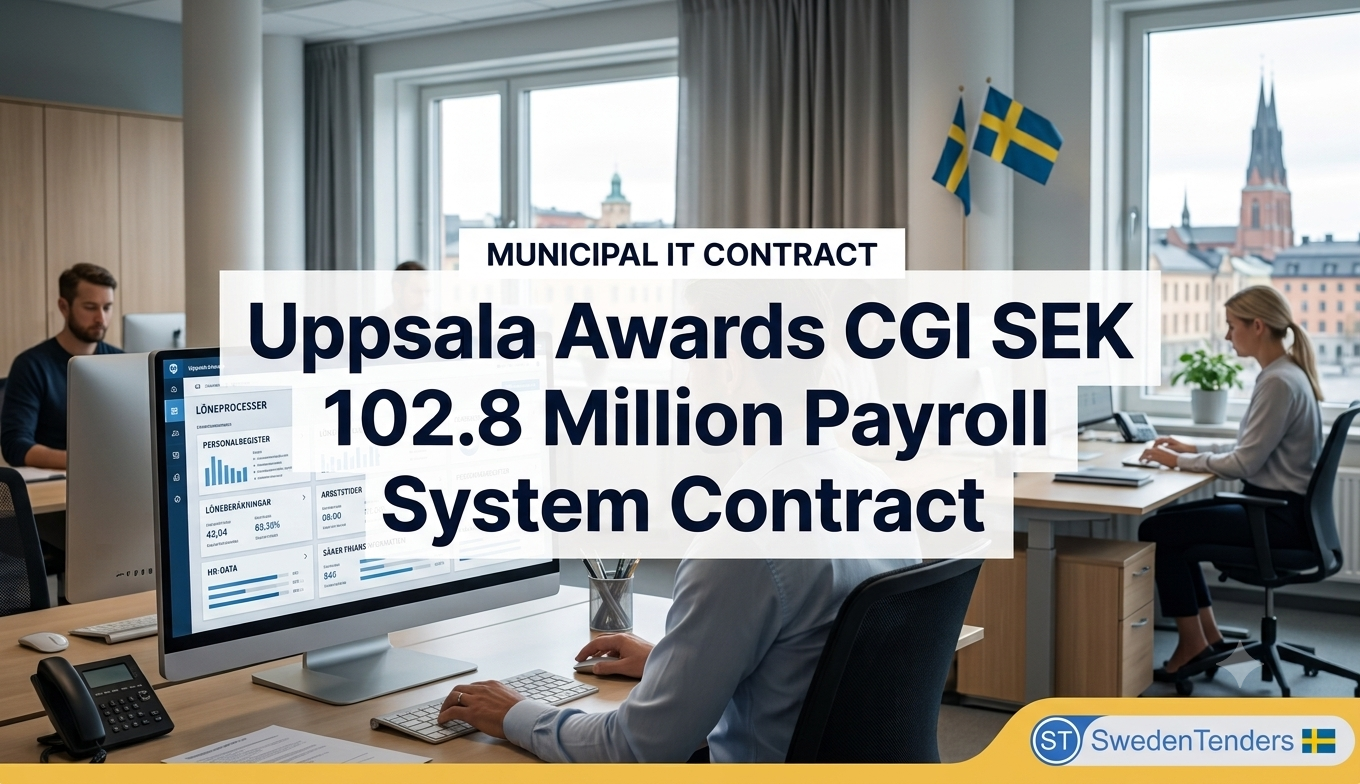
Uppsala Awards CGI SEK 102.8 Million Contract to Modernise Municipal Payroll Systems
13 Jul 2026
Sweden's Uppsala Municipality has selected CGI Sverige AB for a new payroll system contract valued at SEK 102.82 million. The agreement will support one of the municipality's most important administrative functions, but the procurement attracted only one tender, leaving the sole bidder as both the lowest and highest admissible offer. Introduction Every public service depends on people being paid correctly and on time. Teachers, social care workers, administrators, technical staff and other municipal employees may work across different schedules, employment conditions and public service functions. Behind every salary payment sits a complex digital system responsible for calculating working hours, allowances, deductions, leave, pensions and other employment related information. Uppsala Municipality has now selected CGI Sverige AB to provide its new payroll system under a contract valued at SEK 102.82 million. The procurement is designed to replace or renew the municipality's payroll system agreement and establish a long term digital platform for payroll and workforce administration. The contract was concluded on 26 June 2026 and is scheduled to support municipal operations until May 2031, with additional extension possibilities. The award is significant not only because payroll technology is central to the daily functioning of local government. It also raises an important procurement question: why did a technology requirement estimated at SEK 160 million attract only one tender? Why This Contract Matters Payroll systems are often treated as back office software, but their impact extends across an entire public organisation. A modern municipal payroll platform must process large volumes of employee information while supporting different contracts, working patterns, leave arrangements, time reporting rules and statutory requirements. Errors can affect employee income, create additional administrative work and reduce confidence in public sector systems. Reliable payroll technology is therefore not simply an accounting tool; it is part of the operational infrastructure that keeps public services functioning. For Uppsala Municipality, the new agreement creates a long term technology relationship covering payroll and related administrative capabilities. The procurement classifications indicate a broader requirement involving human resources software, time accounting, administrative systems, financial information systems, software development and related IT services. The contract also illustrates the growing importance of digital infrastructure in local government. Municipal authorities increasingly depend on integrated software platforms to automate administrative processes, improve data management and support a large and diverse workforce. Contract Timeline Winner Selected: 29 May 2026 Planned Contract Start: 15 June 2026 Contract Concluded: 26 June 2026 Notice Dispatched: 9 July 2026 TED Publication Date: 13 July 2026 Initial Contract End Date: 1 May 2031 Maximum Renewals: Three Total Extension Period: Up to 48 months Contract Overview Uppsala Municipality launched the procurement to establish a new agreement for a payroll system, known in Swedish as a lönesystem. The procurement covers IT services and software capabilities connected to payroll administration, time accounting, human resources, information systems and related technical support. The municipality estimated the procurement value at SEK 160 million excluding VAT. CGI Sverige AB submitted the only tender and secured the contract at a value of SEK 102,817,000. The agreement is not structured as a framework agreement and does not use a dynamic purchasing system. Instead, it creates a direct contractual relationship between Uppsala Municipality and CGI Sverige for the delivery of the required payroll system services. The contract is scheduled to run until 1 May 2031 and includes up to three renewal opportunities. The notice states that the available extensions total 48 months, potentially extending the relationship beyond the initial contract period. Key Contract Details Detail Information Contracting Authority Uppsala kommun Winning Company CGI Sverige AB Country Sweden Location Uppsala County Procurement Subject New payroll system agreement Sector Municipal IT, payroll and workforce administration software Estimated Procurement Value SEK 160,000,000 excluding VAT Value of Awarded Contract SEK 102,817,000 Procedure Type Competitive procedure with negotiation following prior publication Nature of Contract Services Number of Tenders Received 1 Lowest Admissible Tender SEK 102,817,000 Highest Admissible Tender SEK 102,817,000 Winner Selected 29 May 2026 Contract Concluded 26 June 2026 Initial Contract End Date 1 May 2031 Maximum Renewals 3 Total Extension Period 48 months Main CPV Code 72000000 - IT services: consulting, software development, Internet and support Legal Basis Directive 2014/24/EU Framework Agreement No Dynamic Purchasing System No EU Funding No EU funding involved Government Procurement Agreement Not covered Subcontracting No Review Requests Received 0 TED Notice ID 482752-2026 TED Publication Date 13 July 2026 Project Scope The contract concerns the delivery of a new payroll system agreement for Uppsala Municipality. Although the award notice provides limited detail about individual software functions, its procurement classifications indicate a broad technology requirement extending beyond basic salary calculation. The system may involve capabilities related to payroll administration, time accounting, human resources processes, administrative software, financial information systems, software supply, software development and related technical services. The detailed functional, technical, integration, security and implementation requirements are contained in the underlying procurement documents and are not fully reproduced in the contract award notice. For a municipality, implementation can be as important as the software itself. Payroll platforms may need to exchange information with human resources systems, financial platforms, time reporting tools and other administrative applications while maintaining accurate employee records. The notice does not disclose the implementation timetable, migration plan, number of employees covered, system architecture or hosting model. About the Contracting Authority Uppsala kommun Uppsala kommun, or Uppsala Municipality, is the regional public authority responsible for delivering local public services in Uppsala, one of Sweden's largest and fastest growing municipalities. Its responsibilities include education, social care, urban development, infrastructure, environmental services and municipal administration. In this procurement, Uppsala Municipality acts as the buyer and the organisation signing the contract. Its municipal executive administration and procurement department managed the purchasing process. The payroll system will support an administrative function that affects employees working across multiple municipal services. About the Organisations Involved CGI Sverige AB - Winning Technology Provider CGI Sverige AB was selected as the successful supplier for Uppsala Municipality's new payroll system agreement. The company submitted a tender valued at SEK 102,817,000 and was the only bidder recorded in the contract award notice. CGI Sverige is a large IT services and technology company providing consulting, systems integration, managed services and software related solutions to public and private sector organisations. Under this contract, CGI will be responsible for delivering the payroll system services required by Uppsala Municipality. The precise division between software delivery, implementation, support and other services is not fully disclosed in the award notice. The winning tender does not include subcontracting, indicating that CGI intends to perform the contracted responsibilities without formally declared subcontractors. Förvaltningsrätten i Uppsala - Review Authority Förvaltningsrätten, the Administrative Court in Uppsala, is identified as the review organisation for the procurement. Its role is to consider eligible legal challenges concerning public procurement decisions and ensure that procurement procedures comply with applicable law. The court has no commercial role in the payroll system contract and does not participate in the delivery of the technology. The notice records no complainants or procurement review requests in connection with the award. Procurement Analysis Uppsala Municipality used a competitive procedure with negotiation following prior publication of a call for competition. This procurement method allows a public buyer to invite market participation and then negotiate aspects of the proposed solutions before selecting a supplier. It can be useful for complex technology projects where the buyer may need to assess implementation methods, functionality and service arrangements rather than purchase a standard product solely on price. The procedure was not accelerated. Despite the competitive structure, the municipality received only one tender. CGI's offer was therefore both the lowest and highest admissible tender, at SEK 102.817 million. The notice does not explain why only one tender was submitted. Factors such as technical requirements, integration complexity, migration responsibilities, implementation risk or the limited number of suppliers capable of meeting municipal payroll requirements may influence participation, but these are possible market considerations rather than confirmed reasons. The disclosed award criterion focused on quality and added value requirements, described in the notice as mervärdeskriterier. This indicates that the evaluation considered the supplier's ability to satisfy desirable or value adding requirements rather than treating the procurement as a lowest price exercise. The municipality estimated the procurement at SEK 160 million, while the awarded tender was valued at SEK 102.817 million. The award is approximately SEK 57.18 million below the original estimate, although the notice does not explain the basis of the difference. Additional Procurement Facts Procurement Directive: Directive 2014/24/EU Nature of Contract: Services Procedure: Competitive procedure with negotiation Prior Call for Competition: Yes Accelerated Procedure: No Estimated Procurement Value: SEK 160 million excluding VAT Awarded Contract Value: SEK 102.817 million Framework Agreement: No Dynamic Purchasing System: No EU Funding: No Government Procurement Agreement: Not covered Maximum Renewals: Three Total Extension Period: 48 months Tenders Received: One Lowest Admissible Tender: SEK 102.817 million Highest Admissible Tender: SEK 102.817 million Subcontracting: No Review Requests: None recorded Market & Industry Perspective Public sector payroll systems occupy a specialised part of the government technology market. Municipal employers must manage large workforces operating under different schedules, employment arrangements and administrative rules. Their software requirements can extend across payroll, time reporting, human resources, finance, workforce planning and regulatory compliance. This complexity can favour established technology providers with experience in large public organisations and the capacity to manage long term implementation and support obligations. The single tender outcome may also be relevant to public buyers across Sweden. If large municipal payroll procurements repeatedly attract limited participation, authorities may need to examine whether technical requirements, migration risks or procurement structures create barriers for potential suppliers. For the technology market, the contract reinforces demand for integrated administrative platforms capable of connecting payroll data with wider human resources and financial systems. Future competition may increasingly focus on cloud delivery, automation, employee self service, analytics, cybersecurity and the ability to integrate with existing public sector applications. Economic Significance The SEK 102.817 million award represents a substantial long term investment in municipal digital administration. The contract value is approximately 35.7% below Uppsala Municipality's original estimate of SEK 160 million. However, the notice does not state whether this difference reflects pricing, scope assumptions, contract structure or other commercial factors. The economic importance of the system extends beyond the contract price. Payroll technology supports the accurate and timely payment of municipal employees and can influence administrative efficiency across multiple public service departments. A well functioning system may reduce manual processing and improve information management, although the notice does not provide quantified savings, staffing impacts or expected productivity benefits. The potential extension period also gives the agreement a long operational horizon, making implementation quality and long term system performance important considerations for both the municipality and the supplier. Future Procurement Opportunities The contract may generate future requirements connected to system implementation, integration, data migration, cybersecurity, training, technical support and software development. However, CGI's winning tender does not declare subcontracting, and the notice does not confirm that any of these activities will be procured separately. Beyond Uppsala, other Swedish municipalities may continue renewing payroll, human resources and workforce management systems as older platforms reach the end of their operating life. Technology providers should monitor opportunities involving cloud based payroll systems, employee self service, workforce analytics, automated time reporting and integration between HR and financial platforms. The notice does not disclose a confirmed timetable for future related procurements by Uppsala Municipality. Opportunities for Suppliers Software companies targeting Swedish municipal procurement should prepare evidence of successful payroll and human resources implementations in complex public organisations. Integration capability may be particularly important because payroll systems often exchange information with finance, time reporting, identity management and employee administration platforms. Suppliers should also demonstrate strong data protection, cybersecurity, service continuity and regulatory compliance capabilities. Companies that cannot provide a complete payroll platform may still find opportunities in adjacent areas such as workforce analytics, digital identity, integration services, data migration, testing, employee portals and specialist training. Because the current award does not involve declared subcontracting, suppliers should not assume that downstream opportunities will emerge directly from this contract. What Businesses Should Watch Future payroll and human resources software procurements by Swedish municipalities. Uppsala Municipality's implementation and transition to the new payroll platform. Demand for cloud based public sector administrative systems. Municipal investment in automated time reporting and employee self service. Integration opportunities involving payroll, HR and financial systems. Cybersecurity and data protection requirements for employee information. Future contract extensions under the Uppsala agreement. Whether other major municipal software tenders attract broader supplier competition. Swedentenders.com Procurement Intelligence The most important procurement signal in this award is the gap between the complexity of the procedure and the level of market participation. Uppsala used a competitive procedure with negotiation, a model designed to support dialogue and evaluation in complex procurements. Yet only one final tender was received. This does not mean the contract was directly awarded. The opportunity was published in advance and followed a competitive procurement process. However, the outcome shows that formal competition and effective market participation are not always the same. Payroll system contracts can create high entry barriers because suppliers may need to combine specialised software, public sector knowledge, integration capability, implementation resources and long term support capacity. The award also demonstrates that quality can be central to government software procurement. Uppsala evaluated added value requirements rather than relying only on the lowest price, reflecting the operational importance of a system expected to remain in use for several years. For suppliers, the strategic lesson is to engage early. Understanding a municipality's existing technology environment, migration challenges and workforce requirements before a tender is published can improve the ability to develop a compliant and competitive solution. Future public sector payroll procurements may increasingly reward suppliers that can combine administrative reliability with cloud technology, automation, cybersecurity and data driven workforce management. Supplier Takeaways Monitor Swedish municipal payroll and HR technology contracts well before renewal dates. Build strong public sector references and demonstrate experience with complex workforce rules. Prepare detailed integration and data migration strategies. Prioritise cybersecurity, data protection and service continuity. Do not compete only on price when quality and added value requirements influence evaluation. Develop capabilities in cloud delivery, automation and employee self service. Study single bid procurements to understand possible barriers to wider supplier participation. Key Takeaways Uppsala Municipality awarded CGI Sverige AB a new payroll system contract. The awarded contract value is SEK 102,817,000. The municipality originally estimated the procurement at SEK 160 million excluding VAT. Only one tender was received. CGI's offer was both the lowest and highest admissible tender. The winner was selected on 29 May 2026 and the contract was concluded on 26 June 2026. The initial contract period runs until 1 May 2031. The agreement includes up to three renewals with a combined extension period of 48 months. The procurement used a competitive procedure with negotiation following prior publication. The award does not involve a framework agreement or dynamic purchasing system. CGI declared no subcontracting. No procurement review requests were recorded. Conclusion Uppsala's new payroll system contract demonstrates how essential administrative technology has become to the delivery of modern public services. The SEK 102.8 million agreement will support a function that reaches across the municipality, connecting employee pay with time reporting, human resources, finance and wider administrative processes. CGI's selection provides Uppsala with a long term technology partner, potentially extending beyond the initial 2031 end date through available renewal options. At the same time, the single tender outcome deserves attention. Complex public sector software requirements can narrow the supplier field even when authorities use formally competitive procedures. For technology providers, future opportunities will depend not only on software functionality but also on implementation capability, integration experience, data security and the ability to support public organisations over long contract periods. Frequently Asked Questions What contract did Uppsala Municipality award? Uppsala Municipality awarded a contract for a new payroll system and related IT services. Who won the payroll system contract? CGI Sverige AB was selected as the winning supplier. What is the value of the awarded contract? The contract is valued at SEK 102,817,000. What was the estimated procurement value? Uppsala Municipality estimated the procurement at SEK 160 million excluding VAT. How many tenders were received? One tender was received. CGI's offer was therefore both the lowest and highest admissible tender. Was the contract directly awarded? No. The municipality used a competitive procedure with negotiation following prior publication of a call for competition. However, only one final tender was recorded. When was the contract signed? The contract was concluded on 26 June 2026. How long will the contract operate? The initial contract period runs until 1 May 2031. The agreement includes up to three renewals with a combined extension period of 48 months. Does the contract involve a framework agreement? No. The TED notice states that no framework agreement is involved. Will CGI use subcontractors? No subcontracting was declared in the winning tender. Is the project financed by the European Union? No. The procurement is not financed with EU funds. Why is a municipal payroll system important? A payroll system supports salary calculation, employee information, time reporting and related administrative processes. Its reliability can affect employees and public service operations across the municipality. Source Source: TED (Tenders Electronic Daily) - Contract Award Notice 482752-2026, published on 13 July 2026.
View Details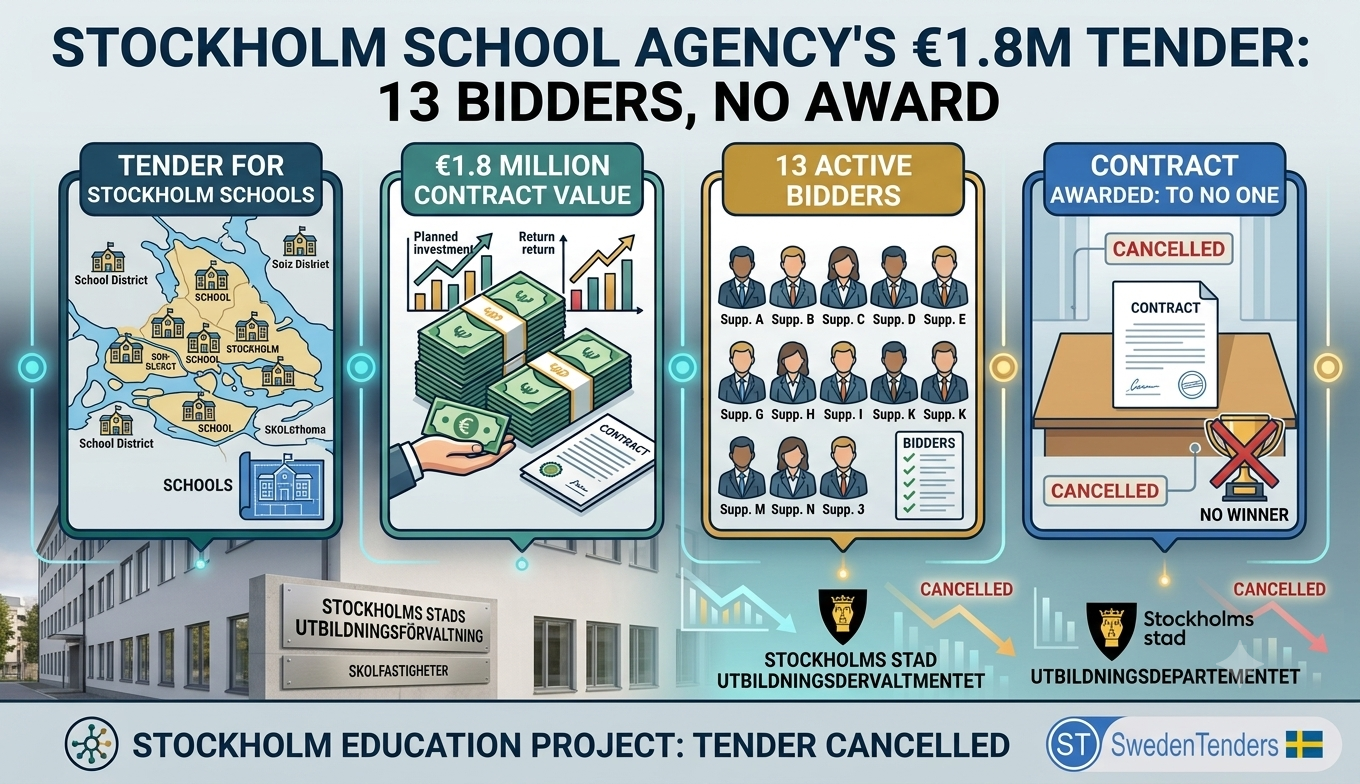
Stockholm's School Building Agency Ran a €1.8 Million Tender With 13 Bidders And Awarded It to No One
10 Jul 2026
Standfirst: Skolfastigheter i Stockholm (SISAB), the company that owns and maintains Stockholm's school buildings, closed a tender for environmental consultancy services worth an estimated SEK 20 million without selecting a winner, despite drawing bids from 13 of Sweden's best-known engineering and environmental consultancies. The outcome is a reminder that even well-contested public tenders sometimes end without an award. Every school renovation and new school building in Stockholm has to clear a set of environmental checks before construction can begin: hazardous materials need to be catalogued, climate impact calculated, and environmental coordination managed across the life of the project. SISAB, the municipally owned company responsible for Stockholm's school properties, went looking for consultants to do exactly that work. Thirteen firms answered the call. None of them got the job. Why This Contract Matters This tender covered three closely related specialisms: environmental coordinators, who manage compliance across a construction project; environmental inventory specialists, who catalogue hazardous materials such as asbestos or PCBs before renovation work begins; and climate calculation specialists, who assess a building project's carbon footprint. All three roles are now standard requirements on Swedish public construction projects, particularly renovation work, known locally as ROT, on ageing school buildings. The fact that this tender closed without an award, despite genuine and substantial competition, is the real story here. Public buyers rarely publicize the mechanics of a failed tender in detail, but the scale of interest , 13 tenders for a two-year, SEK 20 million framework - shows real appetite in the Swedish environmental consultancy market for this kind of recurring public-sector work. Contract Timeline 21 April 2026 - Planned start date for the framework, as specified in the tender. 20 April 2028 - Planned end date for the framework's two-year term. 8 July 2026 - The result notice, confirming no award, was dispatched to the EU Publications Office. 10 July 2026 - The notice was published in OJ S issue 131/2026. Contract Overview SISAB ran an open procedure under the EU's general procurement directive, seeking a framework agreement without reopening of competition for environmental coordination, environmental inventory and climate calculation consultancy services. The estimated value was SEK 20 million over a planned two-year term, from April 2026 to April 2028. Thirteen tenders were received. Despite that field of bidders, SISAB's result notice records that no winner was chosen and the competition was closed. The reason given in the notice is simply "Other," with no further detail disclosed. Every one of the 13 tenders received is listed in the notice as a non-winning tenderer, meaning the entire competitive field went unrewarded. Key Contract Details Contracting authority: Skolfastigheter i Stockholm Aktiebolag (SISAB) Contract title: Miljösamordnare, miljöinventerare och klimatberäkningsspecialist (Environmental coordinators, environmental inventory specialists and climate calculation specialists) Internal reference: SISAB 2025/433 CPV classification: 71313000 - Environmental engineering consultancy services Procedure type: Open procedure, non-accelerated Legal basis: Directive 2014/24/EU Framework type: Framework agreement without reopening of competition (as specified, though ultimately unawarded) Estimated value: SEK 20,000,000 (excluding VAT) Planned duration: 21 April 2026 to 20 April 2028 (two years) Award criteria: Quality-based evaluation Number of tenders received: 13 Winner selection status: No winner chosen; competition closed Reason for non-award: "Other" (not further specified in the notice) GPA coverage: Yes EU funding: Not financed with EU funds Strategic procurement objective: None declared Place of performance: Stockholm County, Sweden Project Scope The intended scope covered consultancy support across every stage of production and design, for both new-build school construction and ROT projects , the Swedish term covering renovation, conversion and extension work on existing buildings. Environmental coordinators would have managed compliance requirements throughout a project's life; environmental inventory specialists would have surveyed buildings for hazardous materials ahead of renovation; and climate calculation specialists would have quantified the carbon impact of construction choices, an increasingly standard requirement on Swedish public building projects. Because no award was made, none of this scope has yet been contracted out. SISAB's underlying need for these services presumably remains, given the estimated SEK 20 million value originally attached to the framework. About the Contracting Authority Skolfastigheter i Stockholm Aktiebolag, known as SISAB, is the company owned by the City of Stockholm responsible for owning, building and maintaining the city's school properties. Classified in the notice as a regional authority, SISAB ran this tender directly and remains the point of contact for enquiries about the procurement and any future re-tender. About the Organisations Involved Skolfastigheter i Stockholm Aktiebolag (SISAB) , Buyer SISAB designed and ran the tender, evaluated the 13 submissions received, and ultimately closed the competition without selecting a winner. It is named in the notice as the organisation providing further information about the procurement procedure, and remains the party best placed to explain what happens next, including whether and when the requirement will be re-tendered. The Thirteen Tenderers All 13 organisations that submitted tenders are named in the notice as non-winning tenderers, since no award was made to any of them. The field included several of Sweden's largest engineering and environmental consultancies alongside smaller specialist firms: Hifab AB (Stockholm) Tyréns Sverige AB (Stockholm) Sweco Sverige AB (Mölnlycke) WSP Sverige AB (Stockholm) AFRY Infrastructure AB (Stockholm) Frank Projektpartner AB (Stockholm) Ramboll Sweden AB (Stockholm) Hedström & Taube Miljö AB (Stockholm) White arkitekter Aktiebolag (Gothenburg) Sustera Green Building AB (formerly Raksystems Dry-IT; Stockholm) Ebab Eko Optima AB (Johanneshov) Bengt Dahlgren Stockholm Aktiebolag (Stockholm) Polygon Sverige AB (Solna) The notice does not disclose individual tender scores, rankings, or the specific reasons any particular bid fell short. Subcontracting status for each tenderer is recorded as "not yet known" across the board. Procurement Analysis SISAB used an open procedure, allowing any qualified consultancy to bid without a pre-qualification stage , a standard approach for professional services contracts of this kind. The intended framework structure, without reopening of competition, would have given SISAB a fixed roster of pre-agreed suppliers to call on directly, without further mini-competitions, had an award been made. The critical fact here is the non-award itself. Thirteen tenders is a strong response for a professional services contract of this size, and the field included nationally significant firms such as Sweco, WSP, Ramboll, AFRY and Tyréns , companies that routinely win large Swedish public infrastructure and construction contracts. That level of interest makes the "no winner selected" outcome more striking, since it was not for lack of competition. The notice attributes the non-award to "Other," a catch-all category in EU procurement reporting that does not specify whether the tender was cancelled due to budget constraints, a decision to revise the specification, a legal challenge, or some other administrative reason. The contracting authority has not disclosed further detail on why none of the 13 bids were accepted. Additional Procurement Facts The competition is formally closed with no winner selected; the notice does not indicate whether or when a new tender will be launched. Any legal challenge relating to this procurement would be heard by Förvaltningsrätten i Stockholm (the Administrative Court of Stockholm), which is also named as the source of further information on review procedures. The procurement is confirmed as GPA-covered, despite the lack of an award. No EU funds were attached to this procurement. No strategic procurement objectives, such as sustainability or social value criteria, were declared for this tender. Market & Industry Perspective The scale and quality of the bidder field says something important about the Swedish environmental consultancy market: this is a competitive, well-populated sector where both large multidisciplinary engineering groups and smaller specialist environmental firms actively pursue public-sector framework work. Firms like Sweco, WSP, Ramboll and AFRY operate across the Nordic region and beyond, and their willingness to compete for a relatively modest SEK 20 million framework indicates how valuable stable, recurring public-sector consultancy work has become in a market where private construction demand can be more volatile. For smaller, more specialised firms in the field, such as Hedström & Taube Miljö or Ebab Eko Optima, competing directly against the largest engineering groups for the same contract reflects a market where scale advantages don't always guarantee success, and where specialist environmental expertise can compete credibly against much larger diversified consultancies. Economic Significance At an estimated SEK 20 million over two years, this framework was a moderate but meaningful contract opportunity, particularly for Stockholm's school construction programme, which depends on properly managed environmental compliance and hazardous material surveys ahead of any renovation work. The non-award means this budgeted spending has not yet translated into an actual supplier relationship, leaving SISAB's environmental consultancy needs unmet through the original tender route. For the 13 firms that bid and lost, the immediate financial impact is limited to the sunk cost of tender preparation, a cost borne by consultancies regularly across the public procurement market, but one that stings more when, as here, no supplier at all is rewarded for the effort of competing. Future Procurement Opportunities SISAB's underlying need for environmental coordination, hazardous material inventory and climate calculation services has not disappeared simply because this tender failed to produce a winner. A re-tender, potentially with a revised specification or evaluation approach, is a plausible next step, though the notice gives no indication of timing. Firms that bid this time should watch for a follow-up notice from SISAB, and more broadly, other Swedish municipal school property companies facing similar renovation and new-build programmes are likely to bring comparable environmental consultancy tenders to market in the coming years, given the sector-wide push toward better-documented environmental compliance in public construction. Opportunities for Suppliers All 13 firms that bid this time should stay alert for a re-tender notice from SISAB, since their prior submissions demonstrate established interest and qualification for this type of work. Consultancies not involved in this round should track SISAB's procurement notices closely, given the clear appetite in the market and the likelihood of a future re-tender. Firms specialising in hazardous material surveys and climate calculation should monitor other Swedish municipal property companies for similar environmental consultancy frameworks, since the underlying regulatory drivers are consistent nationwide. Suppliers should consider requesting a debrief from SISAB where permitted under Swedish procurement rules, to better understand the "Other" justification behind the non-award before any re-tender is issued. What Businesses Should Watch Watch for any announcement from SISAB about a revised or relaunched tender for these environmental consultancy roles, since the underlying need for the work remains. Watch also whether other Stockholm-area public bodies report similar non-award outcomes on comparable environmental consultancy tenders, which would suggest a broader pattern rather than an isolated case specific to this contract. SwedenTenders.com Procurement Intelligence This notice is a useful reminder that competitive interest alone does not guarantee an award. Thirteen tenders, including bids from some of Sweden's most established engineering and environmental consultancies, were not enough to produce a winner here, and the notice's vague "Other" justification leaves the real reason undisclosed. For a market intelligence audience, that opacity is itself informative: not every failed tender stems from a lack of qualified suppliers, and buyers can and do walk away from well-contested competitions for reasons they choose not to detail publicly. For suppliers, the lesson is to treat a strong competitive field as necessary but not sufficient for winning public work. Where a tender closes without an award, following up for a debrief, and watching closely for a re-tender, is likely to be more productive than assuming the opportunity has simply disappeared. The scale of interest this tender attracted strongly suggests SISAB will need to return to the market for these services before long. Expect Swedish municipal property companies to continue treating environmental coordination and climate calculation consultancy as standard, recurring procurement needs, even as individual tenders like this one occasionally fail to produce a result on the first attempt. Supplier Takeaways Stay alert for a SISAB re-tender covering the same environmental consultancy scope, given the clear underlying need and strong market interest. Request a debrief where possible to better understand the "Other" non-award justification before preparing for any future round. Track other Swedish municipal school property companies for comparable environmental consultancy opportunities. Maintain qualification and pricing readiness, since a re-tender could emerge with limited notice given the volume of existing renovation and new-build demand. Key Takeaways SISAB's tender for environmental coordination, inventory and climate calculation consultancy, estimated at SEK 20 million, closed with no winner selected. Thirteen tenders were received, including bids from major firms such as Sweco, WSP, Ramboll, AFRY and Tyréns. The notice attributes the non-award to "Other," without further explanation. The contract was intended to run for two years, from April 2026 to April 2028. Any legal challenge would be handled by Förvaltningsrätten i Stockholm. Conclusion A well-contested tender that ends without a winner rarely makes headlines, but it tells its own story about the mechanics of public procurement. Thirteen credible bidders competed for SISAB's environmental consultancy framework, and the contracting authority chose to award the contract to none of them. For Stockholm's school construction programme, the underlying need for this work has not gone away, and for the market of Swedish environmental consultancies that competed here, the more relevant question now is not who won, but when SISAB returns to the market to try again. Frequently Asked Questions Who ran this tender?Skolfastigheter i Stockholm Aktiebolag (SISAB), the company that owns and manages Stockholm's school properties. Who won the contract?No winner was selected. The competition was closed without an award. Why was no winner chosen?The notice states the reason as "Other" without further explanation. The contracting authority has not disclosed additional detail. How many companies bid for this contract?Thirteen tenders were received. What was the contract worth?The estimated value was SEK 20 million over a planned two-year term. What would the contract have covered?Environmental coordination, hazardous material inventory surveys, and climate impact calculations for Stockholm school construction and renovation projects. Is this procurement covered by the WTO Government Procurement Agreement?Yes, the notice confirms GPA coverage. Where can a legal challenge related to this procurement be filed?Any challenge would go to Förvaltningsrätten i Stockholm, the Administrative Court of Stockholm. Source: EU Official Journal, Contract Award Notice 478575-2026, OJ S 131/2026, published 10 July 2026. Contracting authority: Skolfastigheter i Stockholm Aktiebolag (SISAB).
View Details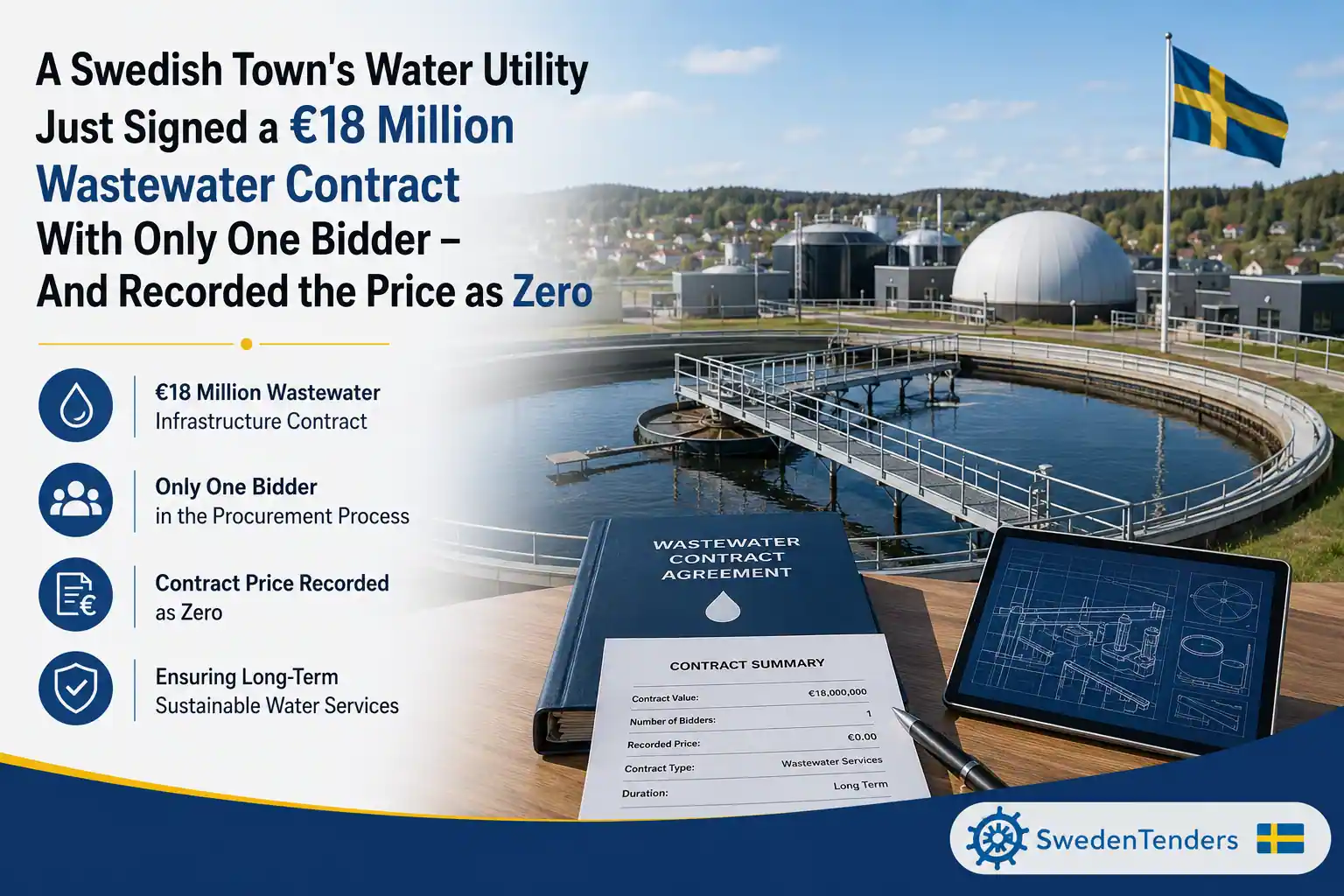
A Swedish Town's Water Utility Just Signed a €18 Million Wastewater Contract With Only One Bidder - And Recorded the Price as Zero
09 Jul 2026
Köping's municipally owned utility is rebuilding its Norsa treatment plant to meet a tighter environmental permit and get ahead of the EU's newly revised wastewater rules, using a collaborative contract model where the final price is still being worked out.StandfirstVästra Mälardalens Energi och Miljö AB (VME), the municipally owned utility serving the Swedish town of Köping, has awarded a roughly 200 million krona contract to rebuild and expand its Norsa wastewater treatment plant. The winner, local construction firm Tuna Entreprenad AB, was the only company to bid. The contract uses a "partnering" delivery model common in Nordic construction, which explains an unusual detail in the notice: the winning tender's recorded value is zero, even though the project's budgeted worth is roughly 200 million krona.IntroductionWastewater treatment plants rarely get rebuilt for their own sake. They get rebuilt because the rules around them changed or because a plant's original permit no longer matches what regulators or the environment, now require. That is exactly the story behind this contract in Köping, a town on the shores of Lake Mälaren in central Sweden.VME needs to adapt its Norsa plant to a new environmental permit and to get ahead of stricter EU wastewater rules that are already on the way. The path it chose to do that and the contract structure it used to hire a builder, are both worth a closer look.Why This Contract MattersWastewater treatment is unglamorous infrastructure that becomes urgent the moment it fails to meet the standard set for it. A plant operating under a new, tighter environmental permit needs upgraded capability and that capability has to be built while the plant keeps treating the town's wastewater without interruption.The contract also matters because of how it was procured: a single bidder, a collaborative pricing model and a notice that records the winning bid at zero krona. Each of those details tells a story about how Swedish municipalities structure major infrastructure works and about the limits of what a public procurement notice can fully capture.Contract Timeline 17 June 2026, Tuna Entreprenad AB was confirmed as the winning tenderer. 6 July 2026, The contract was formally concluded. 7 July 2026, The result notice was dispatched for publication. 9 July 2026, The notice was published in the Official Journal of the EU (OJ S 130/2026). The notice references an earlier related notice, confirming this result follows an original tender announcement published separately.Contract OverviewVME ran an open procedure, not accelerated, to appoint a main contractor to rebuild and expand its Norsa wastewater treatment plant in Köping. The stated purpose, in VME's own words in the notice, is to adapt the plant to a new environmental permit and to prepare it for upcoming requirements under the EU's wastewater directive, with construction proceeding alongside the plant's ongoing treatment operations.Crucially, the contract is being delivered "i Partnering", in partnering, a collaborative project delivery model in which the contractor works jointly with the client to develop the design, sequencing and costs as the project progresses, rather than pricing being fixed competitively before construction plans are finalised. Only one company, Tuna Entreprenad AB, submitted a tender and it was awarded the contract.Key Contract Details Detail Information Contracting authority Västra Mälardalens Energi och Miljö AB (VME), Köping, Sweden Procedure title Reconstruction and expansion of Norsa Wastewater Treatment Plant, Köping, in Partnering Main CPV code 45252127 – Wastewater treatment plant construction work Procedure type Open procedure (not accelerated) Contract delivery model Partnering (collaborative design and build) Estimated value (excl. VAT) 200,000,000 SEK Award criterion Price (sole criterion) Framework agreement None Tenders received 1 Winning supplier Tuna Entreprenad AB (Eskilstuna, Sweden) Recorded value of winning tender 0.00 SEK (see Procurement Analysis) Range of tenders (lowest/highest admissible) 200,000,000 SEK / 200,000,000 SEK Date winner chosen 17 June 2026 Date contract concluded 6 July 2026 Subcontracting Not yet known EU funding Not financed with EU funds GPA coverage No Legal basis Directive 2014/24/EU Contract duration Unlimited (no fixed end date recorded) Review body Förvaltningsrätten i Uppsala (Uppsala Administrative Court) Project ScopeThe project covers adapting the Norsa wastewater treatment plant to comply with a new environmental permit issued to VME, while also preparing the facility for requirements under the EU's revised urban wastewater rules. The European Union adopted a substantial overhaul of its Urban Wastewater Treatment Directive at the end of 2024, introducing stricter nutrient removal standards, new obligations to treat micropollutants such as pharmaceutical residues and a phased push toward energy neutral plant operations by the mid 2040s, with member states required to transpose the rules into national law by mid 2027. Rebuilding a plant now, ahead of those deadlines, lets a utility the size of VME spread the investment over a longer timeframe rather than facing a rushed retrofit later.The work will proceed while the plant continues treating Köping's wastewater, a genuine operational constraint that shapes how construction has to be sequenced, phased and coordinated with ongoing plant operations.About the Contracting AuthorityVästra Mälardalens Energi och Miljö AB (VME) is a municipally owned utility, wholly owned by the municipality of Köping, responsible for the town's water and wastewater services, district heating in Köping and neighbouring Arboga and a range of technical services including streets, parks and public lighting on the municipality's behalf. It is classified in the notice as a public undertaking with general public services as its main activity.As the statutory operator of Köping's public water and wastewater systems, VME carries direct legal responsibility for keeping the Norsa plant compliant with its environmental permit, which is the underlying driver behind this contract.About the Organisations InvolvedVästra Mälardalens Energi och Miljö AB, Buyer and Organisation Signing the ContractBased in Köping, VME structured the tender, evaluated the single bid received and signed the resulting contract directly, a role confirmed twice in the notice. Its procurement was handled through its own procurement unit, with a named contact managing the process throughout.Förvaltningsrätten i Uppsala, Review OrganisationThe Uppsala Administrative Court is the designated review body for this procedure and also serves as the point of contact for further information on the review process. The notice's review deadline field does not contain the usual explanatory text found in most notices of this kind, listing only a numeral rather than a description of the applicable deadline, the contracting authority has not disclosed this information in a readable form within the notice itself.Tuna Entreprenad AB, Winning SupplierTuna Entreprenad AB is based in Eskilstuna, in Sweden's Södermanland region and classified in the notice as a medium sized economic operator. It was the sole tenderer for this contract and was awarded the work outright. The notice records its subcontracting arrangement as "not yet known," consistent with a partnering delivery model in which the full supply chain and cost structure is typically developed jointly with the client as the project progresses, rather than fixed at the point of contract signature.Procurement AnalysisThe most striking feature of this notice is the mismatch in the winning tender's recorded value. The notice states the value of Tuna Entreprenad's winning tender as 0.00 SEK, while separately recording both the lowest and highest admissible tenders received at 200,000,000 SEK, the same figure as the project's own estimated value. Since only one tender was received, that 200 million krona figure almost certainly represents Tuna Entreprenad's own bid, meaning the "0.00 SEK" entry in the winner's tender value field appears to be an artefact of how a partnering contract, without a single fixed lump sum price at the point of award, gets recorded in a structured EU procurement notice, rather than evidence that no money is actually changing hands.That interpretation is reinforced by the contract's classification: price was the sole award criterion, yet with only one bidder, that criterion had no comparative role to play. Partnering contracts commonly proceed to a jointly developed target cost only after the contractor is selected and design work advances, which is consistent with a headline "estimated value" standing in for a genuine fixed price at the point this notice was published.Only one tender was received for a contract of this scale, which is not unusual for a partnering based public works contract: the model favours contractors willing to commit to a collaborative, open book relationship over a long construction period, which naturally narrows the field compared with a standard fixed price competitive tender.The lot's duration is recorded as "Unlimited," with no fixed contract end date specified, another detail consistent with a partnering arrangement where the project's actual programme is refined jointly as the design matures, rather than fixed rigidly at the outset.Additional Procurement FactsThe contract is confirmed as not financed by EU funds and not covered by the WTO Government Procurement Agreement. Zero complaints were logged against the award and the review body's standard information field, which would typically explain applicable appeal deadlines, is not populated with readable text in this notice, a minor but genuine gap in the published data that a supplier considering a challenge would need to resolve directly with the Uppsala Administrative Court rather than relying on the notice alone.Market & Industry PerspectivePartnering as a delivery model has become increasingly common in Nordic public infrastructure, particularly for complex works that must be carried out alongside live operations, such as expanding a treatment plant that cannot simply be switched off during construction. It trades the price certainty of a traditional fixed price tender for closer collaboration on design, sequencing and risk management between client and contractor, an approach many public utilities consider better suited to technically complex, operationally sensitive projects.For contractors, winning this kind of work typically depends less on submitting the lowest number in a sealed bid and more on demonstrating the technical capability and collaborative track record a partnering relationship demands, which likely explains why VME received only one tender for a project of this scale rather than a wider competitive field.Economic SignificanceAt roughly 200 million Swedish krona, this is a substantial capital investment for a utility serving a town the size of Köping, reflecting the real cost of adapting ageing wastewater infrastructure to stricter environmental standards. For a municipally owned utility, a project of this scale is likely to be one of the largest single infrastructure investments undertaken in its current business plan.For the broader Swedish water infrastructure sector, this contract is a visible early example of utilities beginning to invest ahead of the EU's revised wastewater treatment rules, whose stricter requirements on nutrient removal, micropollutants and treatment plant energy performance will progressively force similar investment decisions across the bloc through the mid 2040s.Future Procurement OpportunitiesAs the partnering arrangement progresses and detailed design work advances, VME and Tuna Entreprenad AB are likely to bring in specialist subcontractors for specific elements of the plant upgrade, process equipment, electrical and control systems and specialist water treatment technology among them, creating downstream opportunities for suppliers even though the main contract itself has already been awarded.Other Swedish municipalities and utilities facing similar environmental permit renewals or preparing for the same EU directive's coming deadlines, are likely to bring comparable wastewater treatment upgrades to market over the next several years, offering a repeatable opportunity pattern for contractors and equipment suppliers in this space.Opportunities for Suppliers Approach Tuna Entreprenad AB directly for subcontracting opportunities as the partnering process defines specific work packages, particularly given the notice confirms its subcontracting plans are not yet finalised. Track other Swedish municipal utilities' environmental permit renewals, since the EU's revised wastewater directive will drive a wave of similar treatment plant upgrades over the coming decade. Specialise in technologies aligned with the directive's new requirements, nutrient removal, micropollutant treatment and energy efficient plant operation, as these are likely to feature in the detailed scope of this and comparable future projects. What Businesses Should WatchWatch for VME's disclosure of a firm target cost or final contract value as the partnering process matures; the current notice leaves the genuine price of this project effectively undocumented in structured form.Watch how VME manages construction alongside live wastewater treatment operations, since successful delivery under these operational constraints will likely shape how other Swedish utilities approach similar upgrades.Watch for further Swedish municipal wastewater tenders as the 2027 transposition deadline for the EU's revised directive approaches, which is likely to accelerate similar investment decisions across the country.Swedentenders.com Procurement IntelligenceThis contract is a useful illustration of a structural tension in how partnering style, collaborative delivery models interact with the standardised reporting formats EU procurement law expects. A partnering contract, by design, does not fix a final price at the point of award, the whole point is to develop cost and scope jointly as the project unfolds. Squeezed into a structured notice built around a single "value of the tender" field, that nuance becomes a flatly reported zero, which looks like a data error to anyone reading the notice without context, even though it likely reflects the genuine nature of the contract rather than a mistake.That gap matters for procurement transparency more broadly. As more European public bodies adopt collaborative delivery models for complex infrastructure, particularly projects that must proceed alongside live operations, the structured data feeding into TED notices will need to accommodate contracts where "value" is a moving target rather than a fixed number. Until it does, readers and market analysts need to look past the headline tender value field and interpret the surrounding context, as this notice requires, to understand what a contract is actually worth.For suppliers, the broader signal is that Swedish and Nordic public infrastructure procurement is leaning further into partnering models for technically demanding, operationally constrained projects. Firms that can demonstrate collaborative delivery capability, not just competitive pricing, are best placed to win this growing category of work.Supplier Takeaways Do not take the "value of the tender" field at face value in partnering model contracts; the project's estimated value, not the recorded tender value, is the more reliable guide to contract scale. Build a track record in collaborative, partnering style delivery models, since this appears to be the deciding factor in winning contracts of this kind, more than competitive pricing alone. Watch for subcontracting opportunities as VME and Tuna Entreprenad AB refine the project's design and work packages over the coming months. Anticipate a wave of similar Swedish wastewater treatment upgrades ahead of the EU's 2027 transposition deadline for its revised urban wastewater directive. Key Takeaways VME awarded a roughly 200 million krona contract to rebuild and expand its Norsa wastewater treatment plant to Tuna Entreprenad AB, the only company that bid. The project is being delivered under a "partnering" collaborative model, which explains why the notice records the winning tender's value as zero despite an estimated project value of 200 million krona. The upgrade responds to a new environmental permit and anticipates stricter requirements under the EU's revised Urban Wastewater Treatment Directive, adopted in late 2024. The contract's duration is recorded as unlimited, with no fixed end date, consistent with a partnering arrangement whose full scope and schedule are still being developed. The contract is not financed by EU funds and is not covered by the WTO Government Procurement Agreement. ConclusionA single bidder, collaboratively priced contract to upgrade a mid sized Swedish town's wastewater plant is not, on its face, a dramatic story. But it captures two trends worth watching closely: European utilities beginning to invest ahead of tougher new EU wastewater rules and public procurement data straining to represent contract models, like partnering, that were never designed to produce a single, fixed price at the moment of award.Frequently Asked QuestionsQ1. Why does the notice show the winning tender's value as zero? The contract uses a "partnering" delivery model, in which the contractor and client jointly develop the project's design, schedule and costs after the contractor is selected, rather than agreeing a fixed price upfront. The zero figure likely reflects that no single fixed price existed at the point the notice was prepared, rather than an error in payment terms.Q2. What is a "partnering" contract? It is a collaborative project delivery approach, common in Nordic construction, where the contractor works closely with the client throughout design and construction, refining scope and cost together, rather than competing purely on a fixed price set before the project begins.Q3. Why was there only one bidder for a 200 million krona project? Partnering contracts tend to attract fewer bidders than fixed price tenders, since they require a contractor willing to commit to an open, collaborative relationship over the life of the project rather than simply submitting the lowest price.Q4. What is driving this wastewater treatment plant upgrade? VME needs to adapt the Norsa plant to a newly issued environmental permit and to prepare for stricter requirements under the EU's revised Urban Wastewater Treatment Directive, adopted in late 2024, which introduces tougher nutrient removal, micropollutant treatment and energy efficiency standards to be phased in over the coming two decades.Q5. Is this contract financed by the EU? No. It is confirmed as not financed with EU funds and not covered by the WTO Government Procurement Agreement.Q6. How long will the contract run? The notice records the duration as "unlimited," with no fixed end date specified, consistent with a partnering arrangement whose full programme is still being developed.Q7. Who owns VME? Västra Mälardalens Energi och Miljö AB is wholly owned by the municipality of Köping and is responsible for water, wastewater and district heating services, alongside various technical services, on the municipality's behalf. Source: EU Official Journal, Contract Award Notice 473309-2026, OJ S 130/2026, published 9 July 2026. Contracting authority: Västra Mälardalens Energi och Miljö AB.
View Details