Four Swedish Regions the Size of Half a Country Just Signed One Contract to Rebuild Their Patients' Hips, Knees and Spines
Standfirst
Sweden's four northernmost healthcare regions, covering a landmass larger than England but a fraction of its population, have jointly awarded a multi category framework agreement for orthopaedic implants worth up to SEK 648.7 million (roughly €59 million). Global implant makers Zimmer Biomet, Johnson & Johnson, Link Sweden and Osteotec Nordics are among the winners across a 33 category catalogue spanning shoulder, hip, knee, spine and trauma surgery.
Introduction
Running a hospital in Umeå, Luleå, Sundsvall or Östersund means serving patients scattered across some of the most sparsely populated territory in the European Union. Västerbotten, Norrbotten, Västernorrland and Jämtland Härjedalen together cover roughly half of Sweden's land area but hold only a small fraction of its population, a geography that makes joint purchasing not just efficient but close to essential.
These four regions, known collectively in Swedish healthcare planning as the Northern Healthcare Region ("Norra sjukvårdsregionen"), have run a shared procurement for orthopaedic implants together for close to a decade. Their latest joint framework agreement, structured across 33 separate product categories covering everything from shoulder replacements to spinal fusion systems, has now been awarded, with the confirmed winners in the categories reviewed including Zimmer Biomet Sweden, Johnson & Johnson, Link Sweden and Osteotec Nordics.
Why This Contract Matters
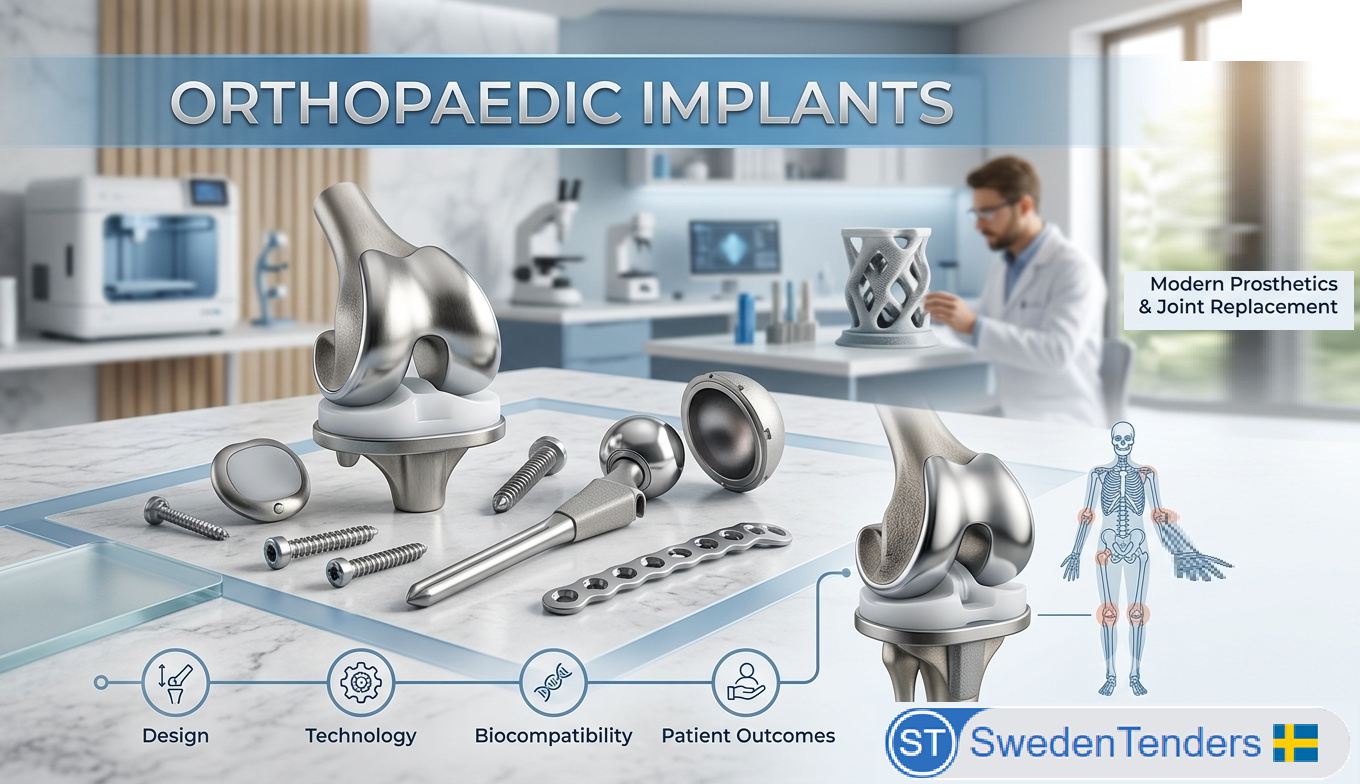
Orthopaedic implants, the metal, ceramic and polymer components that replace or reinforce damaged joints and bones, sit at the centre of some of the most common major surgeries performed in any developed health system: hip and knee replacements, spinal fusion and trauma fixation after fractures. An ageing population and a steady rise in joint replacement surgery across Europe make this category of hospital spending both large and structurally growing.
For four regions that individually would struggle to negotiate the most competitive terms from global implant manufacturers, pooling their purchasing power into a single framework is a straightforward way to secure better pricing and broader product access than any one region could manage alone. It also means a hip or shoulder implant used in a rural hospital hundreds of kilometres from Stockholm is sourced through exactly the same competitive, EU regulated process as one used in a major metropolitan teaching hospital.
Contract Timeline
| Date | Milestone |
|---|---|
| c. 2017–2019 | Predecessor joint framework agreements for orthopaedic implants established between the same four regions |
| 2026 (date undisclosed) | Open tender procedure launched for the renewed framework |
| 11 May 2026 | Winners selected across the reviewed lots |
| 18 June 2026 | Contracts concluded with winning suppliers |
| 17 July 2026 | Award notice published in OJ S 136/2026 |
Contract Overview
Region Västerbotten led a joint procurement on behalf of itself, Region Jämtland Härjedalen, Region Norrbotten and Region Västernorrland, running an open EU wide procedure to establish framework agreements across 33 distinct lots covering shoulder ("Axel"), bone cement ("Cement"), hip ("Höft"), knee ("Knä"), spine ("Rygg") and trauma ("Trauma") implant categories. Each lot was evaluated on the best price quality ratio, with pricing and a number of technical assessment criteria specific to each product category set out in the tender documentation.
The framework agreements were awarded without reopening of competition, meaning each of the four regions can call off supplies directly from the awarded suppliers in their category without running a further mini competition. Award notices reviewed for this article confirm at least four suppliers among the winners, Zimmer Biomet Sweden AB, Johnson & Johnson Aktiebolag, Link Sweden Aktiebolag and Osteotec Nordics AB, with Arthrex Sverige AB named as an unsuccessful bidder in at least one category. Given the scale of the notice, spanning all 33 lots, SwedenTenders.com has focused this analysis on the confirmed details available and recommends consulting the full TED notice for category by category winner detail beyond what is summarised here.
Key Contract Details
| Field | Detail |
|---|---|
| Lead contracting authority | Region Västerbotten |
| Joint buyers | Region Jämtland Härjedalen, Region Norrbotten, Region Västernorrland |
| Title | Ortopediska Implantat |
| CPV code | 33183100 - Orthopaedic implants |
| Procedure type | Open |
| Legal basis | Directive 2014/24/EU |
| Estimated value (full procurement) | SEK 610,000,000 |
| Maximum value of framework agreements (this notice) | SEK 648,732,500 (approximately €59 million) |
| Approximate reestimated value | SEK 480,666,400 (approximately €43.7 million) |
| Number of lots | 33, covering shoulder, cement, hip, knee, spine and trauma implant categories |
| Award criteria | Best price quality ratio ("Bästa förhållande mellan pris och kvalitet"), calculation method set out per category in the tender documents |
| Framework structure | Framework agreement, without reopening of competition |
| Confirmed winning suppliers | Zimmer Biomet Sweden AB, Johnson & Johnson Aktiebolag, Link Sweden Aktiebolag, Osteotec Nordics AB |
| EU funding | None disclosed |
| GPA coverage | Yes |
| Review body | Förvaltningsrätten i Umeå (Administrative Court of Umeå) |
| Place of performance | Västerbottens län and the wider Northern Healthcare Region, Sweden |
Project Scope
The 33 lots reviewed span the full clinical range of orthopaedic reconstruction and trauma care: four shoulder prosthesis categories (modular stemmed, metaphyseal, fracture and reverse shoulder replacement), three bone cement categories, nine hip replacement and revision categories (from standard cemented primary hips through to complex revision stems), four knee replacement categories, seven spine categories (including robotic spine surgery and paediatric scoliosis systems) and six trauma fixation categories (plating systems, intramedullary nails and external fixation).
This breadth reflects the reality that a regional health system needs continuous access to implants across virtually every major orthopaedic procedure, not just the highest volume categories like standard hip and knee replacement. Splitting the framework into 33 separate lots, rather than a smaller number of broader categories, allows the regions to award each specific implant type to whichever supplier offers the strongest combination of price and clinical quality for that particular product, rather than forcing a single supplier to cover the entire orthopaedic catalogue.
About the Contracting Authority
Region Västerbotten led this joint procurement on behalf of the Northern Healthcare Region, a long standing collaborative arrangement among Sweden's four northernmost regions for coordinating major clinical procurement. Together, Västerbotten, Norrbotten, Västernorrland and Jämtland Härjedalen cover an area comparable in size to Sweden's entire southern half, despite having a combined population far smaller than metropolitan Stockholm alone. Joint procurement of this kind, already used by the same four regions for categories ranging from visual aids to wound care equipment to medication dispensing services, is a structural response to that geography: it lets each region access competitive supplier terms it would struggle to negotiate independently.
Region Jämtland Härjedalen, Region Norrbotten and Region Västernorrland are named as joint buyers under this framework, each drawing supplies directly from the awarded categories for their own regional hospital networks.
About the Organisations Involved
Zimmer Biomet Sweden AB, Winning Tenderer
The Swedish subsidiary of Zimmer Biomet, a major global orthopaedic device manufacturer with a broad portfolio spanning joint replacement, trauma and surgical technology. Zimmer Biomet was confirmed as a winner in the shoulder prosthesis category reviewed, reflecting its established position as one of the largest suppliers of shoulder and joint implants to the Swedish public health system.
Johnson & Johnson Aktiebolag, Winning Tenderer
The Swedish arm of Johnson & Johnson, whose medical devices business (operating through its DePuy Synthes orthopaedics division) is among the largest global suppliers of joint replacement and trauma fixation systems. Johnson & Johnson was confirmed as a winner in the shoulder prosthesis category reviewed.
Link Sweden Aktiebolag, Winning Tenderer
The Swedish subsidiary of Waldemar Link, a German orthopaedic implant manufacturer with a long specialism in hip and knee revision systems. Link Sweden was confirmed as a winner across multiple categories reviewed, consistent with the company's established position in the Swedish public procurement market for complex joint replacement implants.
Osteotec Nordics AB, Winning Tenderer
A Nordic focused orthopaedic implant supplier confirmed as a winner across multiple categories reviewed in this framework, reflecting a smaller, more specialised competitor operating alongside the larger multinational device manufacturers in this market.
Arthrex Sverige AB, Non Winning Tenderer
The Swedish subsidiary of Arthrex, a global orthopaedic and sports medicine device company. Arthrex Sverige submitted a tender for the shoulder prosthesis category reviewed but was not selected as a winner in that category; the company has a long history of participating in this same joint procurement across previous rounds of the framework.
Förvaltningsrätten i Umeå, Review Organisation
The Administrative Court of Umeå is designated as the review body for this procurement, providing the legal channel through which any bidder wishing to contest an award decision across the framework's categories can do so.
Procurement Analysis
Running a single open procedure across 33 separate lots, rather than issuing 33 separate tenders, is a deliberate efficiency choice: it lets the four regions publish one consolidated set of tender documents, run one evaluation timeline and award each category on its own merits, while sparing suppliers, many of whom compete across multiple categories, as Link Sweden and Osteotec Nordics appear to here, from navigating a fragmented set of separate procurement processes.
The "best price quality ratio" award methodology, with calculation details left to each category's own tender documentation, reflects how clinically sensitive this category of purchasing is. Orthopaedic implants are not interchangeable commodities: a shoulder prosthesis and a spinal fusion cage demand entirely different technical evaluation criteria, so leaving the precise weighting and clinical assessment method to each category's own documentation, rather than applying one blanket formula across all 33 lots, allows the evaluation to reflect genuine clinical and technical differences between implant types.
The absence of a ranking indicator on winning tenders, combined with the "without reopening of competition" framework structure, suggests each region can call off directly from whichever supplier or suppliers were awarded a given category, without running a further competitive step, consistent with how earlier rounds of this same joint framework have operated since at least 2017.
Additional Procurement Facts
Five tenders were received in the shoulder prosthesis category reviewed in detail, none of them variant bids and none disclosed as involving subcontracting. This is one of the longer running joint procurement collaborations among Swedish regions, with predecessor iterations of this same orthopaedic implants framework dating back to at least 2017 and 2019 according to public procurement records and earlier rounds have included additional suppliers such as Medtronic, Smith & Nephew, Stryker, Swemac Orthopaedics and Tresona Instrument, indicating a broader and more competitive supplier base across the framework's full 33 categories than the subset confirmed in this review. The framework is confirmed as GPA covered and carries no EU funding, financed entirely through the four regions' own healthcare budgets.
Market & Industry Perspective
The Swedish orthopaedic implants market, like most of Europe's, is dominated by a small number of large multinational device manufacturers, Zimmer Biomet, Johnson & Johnson's DePuy Synthes, Stryker, Smith & Nephew and Medtronic among them, alongside more specialised players such as Link (hip and knee revision systems), Arthrex (sports medicine and shoulder) and smaller Nordic focused suppliers such as Osteotec Nordics and Swemac Orthopaedics. Splitting a framework into dozens of narrow clinical categories, as this one does, gives smaller, more specialised suppliers a genuine route to winning individual categories where their product is strongest, rather than being squeezed out entirely by manufacturers with a broader but less specialised catalogue.
The recurrence of the same four northern regions running this joint procurement together over multiple contract cycles, spanning close to a decade, also signals a stable, mature collaborative purchasing model, one increasingly common across Sweden's more sparsely populated northern regions for major clinical categories beyond orthopaedics alone.
Economic Significance
At a maximum framework value of SEK 648.7 million or roughly €59 million, this is a substantial category of clinical spending for four regions with a combined population far smaller than many single Swedish metropolitan areas. Joint procurement of this kind is what allows these regions to access competitive implant pricing at a scale closer to what a much larger single region could negotiate independently, a meaningful structural advantage given the sustained growth in joint replacement and spinal surgery volumes across ageing populations throughout Europe.
For winning suppliers, a multi year position across one or more of the framework's 33 categories provides steady, recurring revenue from four public health systems simultaneously, without the cost of managing four separate regional sales and tendering relationships.
Future Procurement Opportunities
Framework agreements of this kind in the Swedish public health sector typically run for several years before requiring retender and the pattern of this specific joint procurement, recurring roughly every few years since at least 2017, suggests the next competitive opportunity across these 33 categories will emerge again in the coming years. Suppliers not selected in this round, including Arthrex Sverige in the category reviewed, retain a clear route back into the framework at its next renewal, consistent with how the same companies have moved in and out of winning positions across previous iterations of this joint procurement.
Opportunities for Suppliers
Orthopaedic device manufacturers, particularly those with strength in specific clinical niches rather than a full catalogue offering, should treat this framework's category by category structure as a genuine point of entry: smaller or more specialised suppliers can compete directly for individual lots, a particular hip revision system, a paediatric scoliosis system, a specific trauma fixation type, without needing to match a multinational's breadth across all 33 categories. Suppliers of adjacent clinical technology, such as surgical navigation systems, robotic assisted surgery platforms (explicitly referenced in the spine category of this framework) and implant tracking or traceability software, may also find complementary opportunities as regional hospitals implement the awarded implant categories.
What Businesses Should Watch
Three developments are worth tracking. First, how the four regions distribute call off volumes across categories where multiple suppliers were awarded without a ranked order, since that determines each winning company's actual share of the framework's value in practice. Second, whether robotic and computer assisted spine surgery technology, referenced explicitly in this framework's spine category, expands further in future rounds as robotic assisted orthopaedic surgery adoption grows across Swedish hospitals. Third, whether other Swedish regional groupings follow this same joint, multi region procurement model for orthopaedic implants, given its now decade long track record among the four northern regions.
SwedenTenders.com Procurement Intelligence
This framework is a clear demonstration of how geographically large, sparsely populated health systems solve a purchasing problem that more compact regions rarely face: achieving competitive scale despite a smaller combined population. By pooling four regions' orthopaedic implant needs into one 33 category framework, Västerbotten, Norrbotten, Västernorrland and Jämtland Härjedalen access supplier terms and product breadth that none of them could realistically negotiate alone, a model with a demonstrated track record stretching back close to a decade across successive iterations of this same joint procurement.
The granular, 33 lot category structure is itself a notable procurement design choice. Rather than awarding a small number of broad contracts to a handful of full catalogue suppliers, splitting implants into narrow clinical categories preserves competitive access for specialised manufacturers whose strength lies in a specific product type rather than breadth across the entire orthopaedic catalogue. That structure appears to have produced a genuinely mixed winner base in the categories reviewed here, combining large multinational device makers with more focused Nordic and international specialists.
Suppliers watching Nordic public healthcare procurement more broadly should note the durability of this specific four region collaboration: it has now run across multiple contract cycles since at least 2017, suggesting it functions as a stable, ongoing procurement relationship rather than a one off consolidation experiment, a structure likely to persist and potentially to be replicated by other groups of smaller regional health systems facing similar geographic and population constraints.
Supplier Takeaways
- Framework agreements split into narrow clinical categories, as this one is across 33 lots, give specialised manufacturers a genuine route to winning individual product categories without needing full catalogue breadth.
- This four region joint procurement has a demonstrated multi cycle history dating back to at least 2017, suppliers not selected in this round have a track record of returning to compete successfully in subsequent rounds.
- Winning a category without a ranked order among multiple suppliers means actual order volume depends on how the four regions distribute call offs in practice, not simply on being named a winner.
- Adjacent technology areas, surgical navigation, robotic assisted spine surgery platforms, implant traceability software, may find complementary opportunities as awarded categories are implemented.
- Sparsely populated, geographically large health systems across the Nordics are a recurring model for this kind of multi region joint procurement; suppliers active in one Swedish joint framework should watch for similar collaborative structures elsewhere in the region.
Key Takeaways
- Region Västerbotten, together with Region Jämtland Härjedalen, Region Norrbotten and Region Västernorrland, jointly awarded a 33 lot orthopaedic implants framework worth up to SEK 648.7 million (approximately €59 million).
- Confirmed winning suppliers include Zimmer Biomet Sweden AB, Johnson & Johnson Aktiebolag, Link Sweden Aktiebolag and Osteotec Nordics AB.
- The framework covers shoulder, cement, hip, knee, spine and trauma implant categories, awarded without reopening of competition.
- This is a long running joint procurement collaboration among the four northernmost Swedish regions, with predecessor frameworks dating back to at least 2017.
- The contract carries no EU funding and is covered by the WTO Government Procurement Agreement.
Conclusion
Few procurement notices illustrate the practical logic of joint public purchasing as clearly as this one. Four regions spread across roughly half of Sweden's landmass, serving a comparatively small population, have spent nearly a decade refining a shared framework that lets each of them access the same competitive implant pricing and product range as a far larger health system. The 33 category structure means the framework serves everything from a routine hip replacement in Umeå to a paediatric scoliosis correction in Östersund, proof that scale in public procurement is as much about smart structural design as it is about raw purchasing volume.
Frequently Asked Questions
Who led this procurement?
Region Västerbotten, acting jointly with Region Jämtland Härjedalen, Region Norrbotten and Region Västernorrland.
What is the framework worth?
The maximum value of the framework agreements in this notice is SEK 648,732,500, approximately €59 million, with a reestimated approximate value of SEK 480,666,400.
Which suppliers won contracts under this framework?
Confirmed winners in the categories reviewed include Zimmer Biomet Sweden AB, Johnson & Johnson Aktiebolag, Link Sweden Aktiebolag and Osteotec Nordics AB.
How many product categories does the framework cover?
33 separate lots, spanning shoulder, bone cement, hip, knee, spine and trauma implant categories.
Is this a new arrangement between these regions?
No. These four regions have run joint orthopaedic implant procurements together since at least 2017, making this the latest iteration of a long standing collaborative purchasing model.
Was any EU funding involved?
No. The notice confirms the framework is not financed with EU funds.
Why do four regions procure this together rather than separately?
Västerbotten, Norrbotten, Västernorrland and Jämtland Härjedalen together cover a vast, sparsely populated area of northern Sweden; pooling their purchasing power secures more competitive supplier terms than any one region could negotiate alone.
Source: EU Official Journal, Contract Award Notice 495946-2026, OJ S 136/2026, published 17/07/2026. Contracting authority: Region Västerbotten.

Fresh and verified Tenders from Sweden. Find, search and filter Tenders/Call for bids/RFIs/RFPs/RFQs/Auctions published by the government, public sector undertakings (PSUs) and private entities.
- 1,000+ Tenders
- Verified Tenders Only
- New Tenders Every Day
- Tenders Result Data
- Archive & Historical Tenders Access
- Consultants for RFI/RFP/RFQ
- Tender Notifications & Alerts
- Search, Sort, and Filter Tenders
- Bidding Assistance & Consulting
- Customer Support
- Publish your Tenders
- Export data to Excel
- API for Tender Data
- Tender Documents

Fill out the form below and you will receive a call from us within 24 hours.
Get FREE SAMPLE TENDERS from Sweden in your email inbox.
Copyright © 2014-2026 SwedenTenders.com. All Rights Reserved.